
Stefan Kölsch
Good Vibrations
Good Vibrations is written so that readers can open it anywhere and immediately find something that speaks to them. You can simply turn to a chapter that connects with what matters to you right now: perhaps the sections about emotional wellbeing, stress reduction, and resilience; or those about how music helps people with dementia, stroke, or Parkinson’s disease; or the chapters showing how music can support children whose language or learning develops in atypical ways.
Each chapter can stand on its own. Some readers might be most interested in the neuroscience, how music engages the brain’s networks for emotion, movement, and memory, or how it influences hormones and the immune system. Others might turn to the practical sections that explain how music can help in everyday situations: how it can calm anxiety, support concentration, ease chronic pain, or help someone reconnect with loved ones through song.
One reader with Parkinson’s disease told me after finishing the relevant chapter: “Every patient should know this!” I was deeply moved by that comment, because that is precisely why I wrote the book—to make scientific knowledge about the effects of music accessible to everyone who could benefit from it, whether they are patients, family members, or therapists.
Another reader, Martyn Ware (the founder of The Human League and Heaven 17) told me that he began by reading the chapter about music and emotions in the brain, planning to mark the most interesting passages for our podcast conversation. After a few pages, he gave up because he realised he wanted to earmark every single page. I take that as the best possible compliment: that the book invites curiosity and feels alive wherever you open it.
Ultimately, this book is for everyone who feels that music has something profound to offer: whether you are a musician curious about the science behind your art, a music therapist looking for new tools, a healthcare professional, or simply someone seeking balance, joy, or healing. Wherever you open Good Vibrations, I hope you will find words that enlighten, encourage, and inspire. And that the “good vibrations” of the book itself will begin to resonate within you.
My hope is that the therapeutic power of music will be recognised and used much more widely than it is today. At the moment, music’s potential for health and healing is still massively underused. We live in a world that often treats health as something purely medical, something to be restored with pills, procedures, or protocols. But human beings are not just chemical systems; we are also emotional, social, and musical beings.
Music is not a replacement for medication, of course. The effects of music are usually smaller than those of a strong drug. A blood pressure tablet will lower your blood pressure more effectively than calming music; an opioid will suppress pain more quickly than a song; and dopamine medication for Parkinson’s disease has much stronger effects than the dopamine release evoked by music. Yet music has one unique advantage: it does all of this at the same time! It regulates heart rate and breathing, reduces stress hormones, stimulates dopamine, releases endorphins, strengthens social bonds, and brings pleasure and meaning. No pill can do all of that simultaneously, and without side effects.
So one wish is very practical: that we will use music more often in healthcare, in prevention, and in everyday life. In hospitals and clinics, where anxiety and loneliness are common, music can make care more humane. In schools, it can support emotional development, empathy, and resilience. In workplaces, it can reduce stress and foster cooperation. And at home, it can help us reconnect: with ourselves and with others.
But there is also a larger wish behind the book. In an age increasingly shaped by artificial intelligence, where human contact risks being replaced by interaction with machines, music reminds us of what it means to be human. When we sing together, our breathing synchronises; our hearts, our movements, our emotions align. This is a deeply biological form of connection, one that has been evolutionarily tested for hundreds of thousands of years.
So if there is one message I hope Good Vibrations leaves with its readers, it is this: music is one of the most powerful ways to nurture both individual and collective wellbeing. It strengthens the mind, heals the body, and unites people across boundaries. And in a time when we need connection more than ever, I would choose the harmony of human voices over the artificial “connection” of machines. Any day.
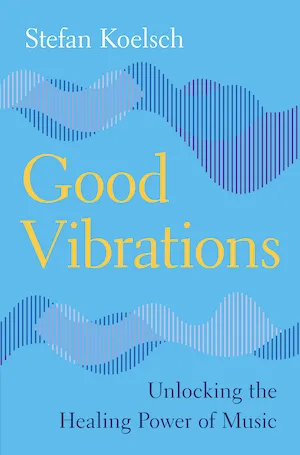
Good Vibrations
Stefan Kölsch (2025). Good Vibrations: Unlocking the Healing Power of Music Cambridge University Press 346 pages, 6.25 x 1 x 9.25 inches ISBN 978-1009366779
Available here →January 5, 2026
20260105-kolsch-stefan-on-good-vibrations
A close-up
The rest of this thread

Stefan Kölsch
Stefan Kölsch is a German–American–Norwegian neuroscientist, psychologist, violinist, and bestselling author whose work explores how music shapes the brain, emotions, and health. He studied music, psychology, and sociology in Germany, completed his PhD at the Max Planck Institute for Human Cognitive and Brain Sciences, and held positions at Harvard Medical School, the University of Sussex, and the Free University of Berlin. He is now Professor of Biological and Medical Psychology and Music Psychology at the University of Bergen, Norway.
Kölsch is internationally recognised for pioneering research on the neural foundations of music and emotion. His studies revealed that music activates the same brain systems involved in emotion, reward, and social bonding, findings that have transformed our understanding of how music can promote mental and physical wellbeing.
Bridging science, art, and human experience, Kölsch’s work aims to make complex research accessible to everyone. In Good Vibrations, he shows how melodies and rhythms can heal, connect, and inspire us, offering practical insights for musicians, therapists, healthcare professionals, and anyone who wants to use music to live a healthier and more fulfilling life.
Pull this thread
Music is a biological force that does what no single drug can, and medicine massively underuses it.
Know something the rest of us don't?
Most threads on Rorotoko begin with our invitation. Any thread can begin with a proposal: you write it with the same prompts every thread answers, and we review it.
Propose a thread →