
A close-up
February 7, 2026
Kanpai
Well, if the book is in the bookstore, that's great. And if someone picks it up, even better. I'm very happy with the cover. My wife did the watercolor and the cover, and she did several other ones inside the book. I think they turned out pretty well. I think sake is a very mysterious beverage in some ways. For Westerners, at least, if we get a drink—a clear liquid poured into small glasses—we think it's a distilled beverage, we think it's a shot. And yet, sake is not a distilled beverage. It has high alcohol, like 16%, but the whole process of making it is different from a distilled beverage. And as people develop an appreciation for sake's long history and its role in Japanese culture and Japanese foodways, I think they will be surprised by a lot of things.
Nowadays, if you look at sources online about sake, there's a lot of discussion about food pairing. Like, what sake goes with what foods? Sake's very versatile in that regard. Maybe more versatile than wine, because with wine, red wines, you have certain types of foods, and white wines, etc. But with sake, you know, there's a lot of flexibility. There's certain sakes you wouldn't serve with heavy foods, but yet there's certain sake that you would. But this whole concept of, like, pairing sake with foods is very, very recent in terms of Japanese history. People didn't think that way with sake. Sake was very important in samurai ritual, but in terms of food pairing, I think that comes from wine culture, and it's very recent.
I worked in a restaurant in Kyoto in the 90s, it was a very upscale restaurant. I was a waiter. And we only had 2 sake on the menu. Most people drank beer or tea. So, even back then, there wasn't a conception that you had to pair sake with food.
Westerners appreciate the approach of pairing with food. 'I'm gonna have fish tonight, what sake goes with it?' And I think a lot of brewers in the United States want to push people beyond thinking sake is just for Japanese food. One of them told me, 'sake is for pizza, sake is for hot dogs'.
There are a lot of varieties of sake, from very top shelf to bottom shelf. And it usually has to do with levels of refinement. And then there are different brewing methods, too. There are really hundreds of varieties of sake. The Japanese government thinks of sake in terms of how much the rice has been milled. And that indicates a premium sake. So there is that. And in North America, it seems like the most popular type of sake is this unfiltered 'nigori sake', this cloudy sake. That in a way, reflects sake's long history of being this unfiltered beverage. In Japan today, there is 'nigorizake', but it's not quite as popular as it is in the United States, where people use that as a base to mix in different flavorings, like coffee. There are a lot of varieties and a lot of ways of preparing sake, even though you are starting with the same ingredients of rice and yeast, and mold. You can do quite a lot just with those things. And then when you start tinkering even more, there are lots of possibilities.
People are really pushing the envelope—they're adding flavorings. There is a carbonated version of sake too. And a lot of these innovations have developed here, in the United States, which is kind of interesting, To write this book, I spoke to at least a dozen breweries all over the United States. Those brewers are a really dynamic, exciting bunch, and that was one of the best parts of this research.
I hope if people read it, they'll take away a better understanding of what sake is, and its long history. When we talk about Japanese culture, we think of tradition, and that weighs very heavily. That's a good thing, because traditions can be very powerful, but oftentimes, it can give us this false sense that things have never changed. I wrote a book about sushi, and it was surprising to me that in that sushi book, just like sake, things are constantly changing. You know, there's never a point where we can say, 'this is what sushi is', because it keeps evolving.
Yet some people are kind of purists about it. They'll say, 'oh the California roll is not really sushi'. I would disagree. I think sushi's constantly evolving. It used to be a food that took years to make, and now people want to eat it when it's just made. There has been an evolution there. And then sake, too. It's amazing how much it's changed throughout the years. On the one hand, tradition can be very powerful, but we have to realize, too, that there has been a lot of change historically. I think that's one of the powers of history, to illuminate what's changed. And then we can realize there are so many possibilities. We don't have to think that sushi is something that only some master craftsman can make. It's something that we can make at home. Or sake, too. We could brew it at home, like I did. It's not that difficult.
The book has some recipes in there if people want to try it at home. I did that with my sushi book, too, and it's not that difficult. And then I also talk about home brewing, the history of that in Japan. I talk about how once it was just so widespread, but then it was made illegal at the end of the 19th century, and it kind of came back in the 1970s. Activists, people on the left were asking for greater rights—they said that homebrewing was their constitutional right to the pursuit of happiness—it was their right to be able to drink their own brew at home. It didn't go very far. But still, it's an interesting story that I tell.
Curator: Bora Pajo
.jpeg)
Kanpai
Rath, Eric C. Kanpai: The History of Sake Reaktion Books, 352 pages, 6.14 x 8.19 inches, ISBN: 9781836391159
Get the book →February 7, 2026
20260117-eric-rath-on-kanpai-history-of-sake-3
The rest of this thread
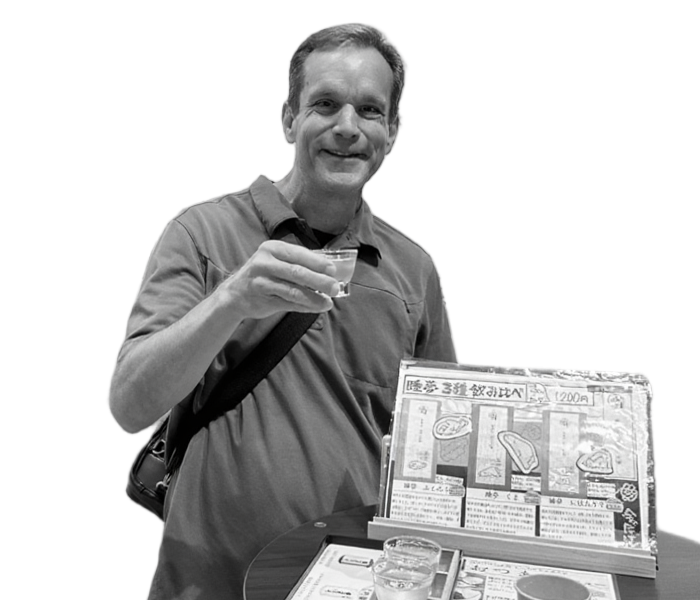
Eric C. Rath
Eric C. Rath is a historian of traditional Japanese food culture at University of Kansas. His books include Food and Fantasy in Early Modern Japan (University of California Press, 2010), Japan’s Cuisines: Food, Place and Identity (Reaktion Books, 2016), and Oishii: The History of Sushi (Reaktion Books, 2021). He is a member of the editorial collective of Gastronomica: The Journal for Food Studies.
Feature your book, your art, your project
Publishing with a small press, or on your own?
A Sponsored Thread runs like every other thread on Rorotoko: three parts on three dates, the same editorial review, your own pages in the archive. Marked Sponsored. $199, paid only once accepted.
Get featured →