
Christine M. E. Guth
Exemplary Things
Exemplary Things investigates the history of a Japanese cultural keyword, meibutsu, and the pervasive influence it has had in shaping consumption practices in Japan. It's a term that has no exact anglophone equivalent. Japanese commodity culture developed in the 15th century, and in Exemplary Things, I show how, since that time, this term has been used to codify, to valorize, and to promote consumerism in a way that transcends distinctions between the arts and crafts, between high and low, and between manufactured and natural products. This book is the first sustained, critical analysis a la longue durée of meibutsu as a concept, a thing, and a category.
To show its multifaceted dimensions, I begin by looking at the word’s ancient lexical origins and at other words, such as meisho, famous place, with which it's interwoven. Although the focus of the book is primarily pre-modern, I also show the ongoing influence of this term to Japanese cultural values in the modern era. Even today every Japanese knows the term meibutsu. Most people assume it refers exclusively to Japanese regional foodstuffs, but that is only one part of its meaning. It in fact has deep roots in elite culture; many exemplary things designated meibutsu were luxury imports from continental Asia that aroused artistic admiration. These objects came to encode information that was indispensable to cultural literacy in the pre-modern period.
Meibutsu is formed from two Chinese characters 名and 物; the first means name, fame, or reputation, and the second means thing, both material and immaterial. The composite can be understood within three overlapping categories. First, is as a thing with a personal name. In pre-modern Japan, lots of things could be given personal names, much as in medieval Europe King Arthur’s sword was named Excalibur. The second meaning, by extension, is a thing with a reputation, or a famous thing. This came about through the creation of systematic lists of famous things—very often artworks that had belonged to the political or social elite, or to great connoisseurs. These included artifacts of exemplary quality such as swords, paintings, calligraphy, ceramics and other articles used in the tea ceremony, but also rare incense woods. The third meaning, which is the dominant one today, is as a quality product specific to a particular region. There are all kinds of famous regional products in Japan—foods, such as radishes, soba noodles, and soups, as well as crafts—bamboo baskets, lacquer, and textiles, to name only a few. The list of such meibutsu exploded in the 18th and 19th centuries with the growth of domestic tourism.
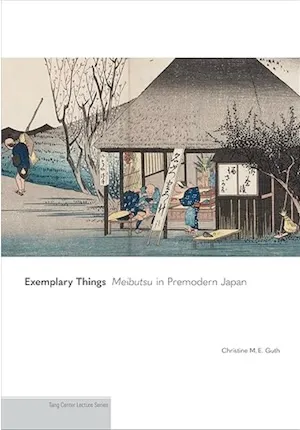
On the cover of my book, there's a picture of a woodblock print by Hiroshige from the late 18th century showing two travelers on the main road linking Kyoto and Edo—modern-day Tokyo. They've stopped at a humble rest-stop to have a soup called tororojiru. Outside the shop, there's a sign saying, “You can have meibutsu soup here.” There's still an inn at this very location in Mariko that sells tororojiru today. This is an example of the way this term continues to have an impact on contemporary consumer culture. In this sense, the term meibutsu very much links up with the notion of heritage branding today.
Curator: Bora Pajo
Exemplary Things
Christine M. E. Guth, Exemplary Things: Meibutsu in Premodern Japan, Princeton University Press, 208 pages, 7 x 10 inches, 63 color illus. ISBN: 9780691274478
Available here →January 29, 2026
20260129-guth-christine-exemplary-things
In a nutshell
The rest of this thread

Christine M. E. Guth
Christine M.E. Guth is a historian of Japanese art and material culture who taught in the Royal College of Art and Victoria and Albert Museum’s History of Design Program from 2007 until 2016. Her wide-ranging scholarship explores art collecting and canon formation, craft practices, and more recently, food culture, with a particular focus on cross-cultural relations. Her books include Art, Tea, and Industry: Masuda Takashi and the Mitsui Circle (Princeton, 1993), Longfellow’s Tattoos: Collecting, Tourism, and Japan (Washington, 2004) Hokusai’s Great Wave: Biography of a Global Icon (Hawaii, 2015), Craft Culture in Early Modern Japan: Materials, Makers, and Mastery (California, 2021). Exemplary Things: Meibutsu in Premodern Japan grew out of lectures presented as part of the Princeton University Tang Center Lecture Series.
Pull this thread
Meibutsu is one interlinked system of named, famous and regional things, rooted in elite connoisseurship rather than regional food.
Know something the rest of us don't?
Most threads on Rorotoko begin with our invitation. Any thread can begin with a proposal: you write it with the same prompts every thread answers, and we review it.
Propose a thread →