
Christine M. E. Guth
Exemplary Things
I've been fascinated with the term meibutsu for a long time. In 1993, I published a book about Japan’s industrialist collectors. While writing it, I became intrigued with the fact that these nouveau riche collectors sought out works of art that had been classified as meibutsu in catalogs of the collections of Japan's previous feudal rulers. Industrialists competed with one another to acquire these emblems of wealth and socio-cultural status, not unlike their American contemporaries, J. Pierpont Morgan and Henry Clay Frick competed to purchase masterpieces from European royal collections. And I thought, this is really interesting. What is it about this label that has given it such pervasive and enduring power? I knew writing a holistic study of the topic was too ambitious to take on at the time, but more than thirty years later, I felt ready to take on the challenge of writing something to reveal how this term arose and evolved over time. No Japanese or American scholar has really unpacked meibutsu in this way. People have looked at it from one angle or another, but not as a taxonomic system whose constituents are interlinked and mutually influential.
Curator: Bora Pajo
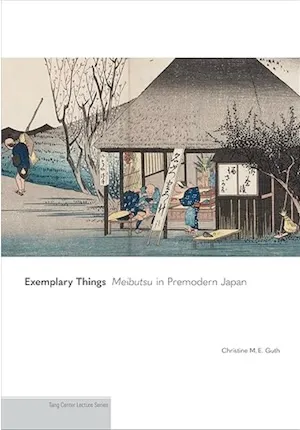
Exemplary Things
Guth, Christine M. E. Exemplary Things: Meibutsu in Premodern Japan. Princeton: Princeton University Press, 2025. ISBN-13: 978-0691274478.
Available here →January 29, 2026
20260212-christine-guth-exemplary-things
The wide angle
The rest of this thread

Christine M. E. Guth
Christine M.E. Guth is a historian of Japanese art and material culture who taught in the Royal College of Art and Victoria and Albert Museum’s History of Design Program from 2007 until 2016. Her wide-ranging scholarship explores art collecting and canon formation, craft practices, and more recently, food culture, with a particular focus on cross-cultural relations. Her books include Art, Tea, and Industry: Masuda Takashi and the Mitsui Circle (Princeton, 1993), Longfellow’s Tattoos: Collecting, Tourism, and Japan (Washington, 2004) Hokusai’s Great Wave: Biography of a Global Icon (Hawaii, 2015), Craft Culture in Early Modern Japan: Materials, Makers, and Mastery (California, 2021). Exemplary Things: Meibutsu in Premodern Japan grew out of lectures presented as part of the Princeton University Tang Center Lecture Series.
Pull this thread
Meibutsu is one interlinked system of named, famous and regional things, rooted in elite connoisseurship rather than regional food.
Know something the rest of us don't?
Most threads on Rorotoko begin with our invitation. Any thread can begin with a proposal: you write it with the same prompts every thread answers, and we review it.
Propose a thread →