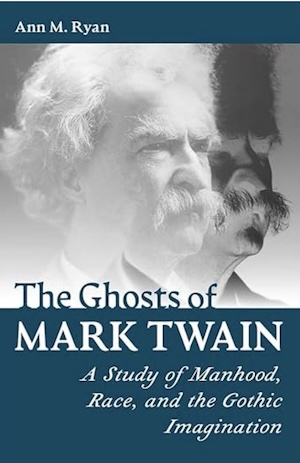
Mark Twain didn’t believe in ghosts—at least, not the sort that rattle chains or float down darkened corridors. This fact, however, appears to carry no weight in the afterlife. Only a few years after his death, a number of psychics and mediums began to conjure the ghost of Mark Twain. And with an impressive regularity, the ghostly Twain appeared on cue, keen to perform and willing to offer advice. The ghost that appeared to each of these psychics was strikingly similar. Twain arrived from the netherworld with personal advice, career and publication suggestions, religious reflections, and regrets about his blasphemies and heresies. This spiritual manifestation of Mark Twain was a patient, sweet-tempered, father figure, a devout Christian and a writer happy to share the spotlight, a benign humanitarian with no racial animus who preferred folksy quips to biting satire. In other words: he was nothing like the actual Mark Twain.
This fascinating bit of Twain trivia is just one specimen of the passionate desire to keep Mark Twain—or at least a version of him—alive in American culture, though not necessarily relevant to it. For many of his admirers, some of whom may not have read his works, Twain is an artifact of Americana, a symbol of homespun wisdom and decency. However, the effort to keep a comforting avatar of Twain present in the culture demands economic, pedagogic, and intellectual investments. In lesson plans, at tourist sites, and in a steady stream of literary and biographical criticism, Twain’s legacy has been maneuvered and manipulated to represent his racial attitudes as being wholly progressive. Maintaining those investments, however, requires that we forget the darker truths which inspired his writing and haunted his life.
The Ghosts of Mark Twain contrasts two divergent movements: one that resurrects a Twain who never lived; and Twain’s own conflicted effort to bury true stories that he also yearns to tell. In an act of literary archeology, this volume examines Twain’s unpublished, fragmentary writings, looking for evidence of buried truths. In these marginalized pieces, Twain seems to remember the stories he ought to tell—often stories of brutal White fathers and the Black sons who resist them; and yet, as he revises, pigeonholes, and excises—to quote Huck Finn—he “disremembers” them as well. Written into the record of these fragments is Twain’s desire to be a different kind of White man, just as their incomplete nature demonstrates how often he stumbled in that effort.