
Marian Stamp Dawkins
Who is Conscious?
My motivation for writing this book was – to put it bluntly – annoyance. What annoyed me so much was the certainty with which people now talk about animal consciousness and what animals feel, using evidence that, in my view, simply did not stand up to scrutiny. This posed a problem. How could I write a book that pointed out the flaws in some of the evidence about animal consciousness without sounding as though I was at the same time making the argument that animals were not conscious at all? So I have had to make it clear that questioning is not the same as disagreeing and that pointing out where arguments are weak is an essential part of progress towards any sort of real understanding.
I have two reasons for assuming this role of awkward questioner. The first is that issues about animal consciousness have immediate practical implications. What you choose to eat and to wear, your view of whether animals should be kept in zoos or used in scientific experiments, whether and how pests should be controlled and whether some animals deserve better treatment than others – these and many other issues depend on your view of which of them are conscious.
We all have to decide our attitudes to animals and so we all need to know not just what the evidence on animal consciousness is, but also how good it is. Think Devil’s Advocate. Think trial by jury. Questioning exposes weaknesses but it strengthens the case where the evidence survives it.
The second reason is consciousness itself. Consciousness – both in ourselves and in other species – is still profoundly mysterious. We do not understand what makes the lump of nervous tissue that makes up our brains feel anything. We understand what it is made of, how its component nerve cells interact and quite a bit about how it receives and sends messages to the rest of the body. But we do not understand how our brains give rise to subjective experiences such as pain and pleasure. We do not understand why, as the philosopher David Chalmers put it, all the brain’s activity does not go on ‘in the dark’, free of any ‘inner feel’. I wanted to emphasize how much we still have to learn. Questioning the received wisdom and pointing out problems with widely accepted views seemed an important contribution to make.
Curator: Rachel Althof
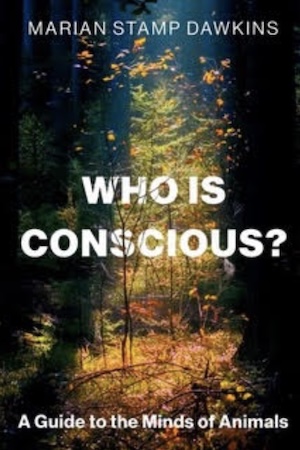
Who is Conscious?
Marian Stamp Dawkins, Who is Conscious? A Guide to the Minds of Animals, Oxford University Press, 160 pages, ISBN: 9780197818626
Get the book →February 22, 2026
20260222-marian-stamp-dawkins-guide-to-the-minds-of-animals
The wide angle
The rest of this thread
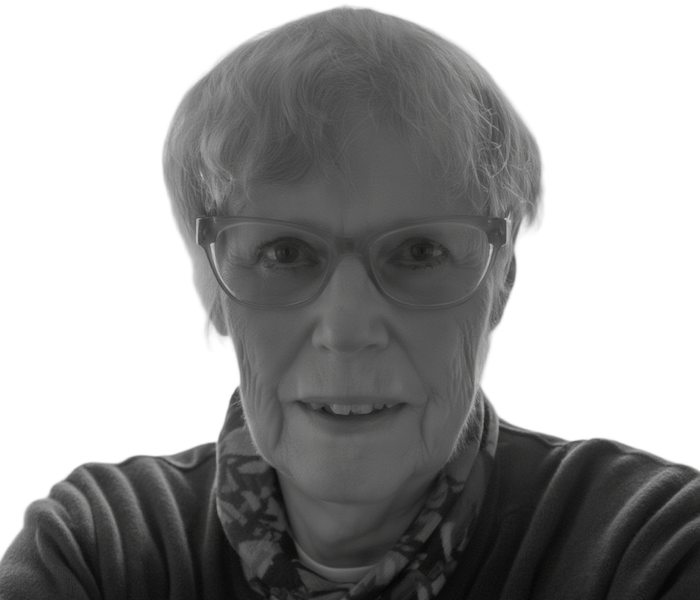
Marian Stamp Dawkins
Marian Stamp Dawkins is Professor of Animal Behaviour in the Department of Biology at the University of Oxford and Fellow Emeritus in Biological Sciences at Somerville College, Oxford. Her research interests are in animal welfare, animal communication and animal consciousness and she has a particular concern with the process of putting welfare research into practice. She has worked on the welfare of poultry for many years in collaboration with various industrial partners in both Europe and the United States and is currently engaged in developing an automated system for assessing the welfare of broiler chickens using image processing of flock behaviour (OpticFlock). In addition to publishing many research papers, she is the author of Animal Suffering: the Science of Animal Welfare (1980), Through Our Eyes Only? The Search for Animal Consciousness (1993), Why Animals Matter: Animal Consciousness, Animal Welfare and Human Well-Being (2012) and The Science of Animal Welfare: Understanding What Animals Want (2021). With Aubrey Manning, she co-authored An Introduction to Animal Behaviour (4th-6th editions). Marian was awarded the Niko Tinbergen Medal by the Association for the Study of Animal Behaviour in 2009, the Robert Fraser Gordon Medal by the World Poultry Association 2011, the Universities Federation for Animal Welfare Medal in 2012 and the Patrick Moore Award by the RSPCA in 2014. In 2014 she was made a Fellow of the Royal Society and awarded the CBE for services to animal welfare. In 2018 she was made an Honorary Fellow of the Society for Applied Ethology. Her latest book, Who is Conscious? A Guide to the Minds of Animals is available as open access from Oxford University Press.
Know something the rest of us don't?
Most threads on Rorotoko begin with our invitation. Some begin with a proposal. Both use the same prompts and the same editing, with your own pages in the archive. Proposed threads carry a small Sponsored label and a fee.
Propose a thread →