
Kevin Landis
One Public
The book is pretty expansive, and so I would imagine any lover of theatre would find something in the manuscript that grabs them. I intentionally wrote an academic book for a wide audience. It’s not a difficult read but at the same time, it really dives deep into the role of theatre in contemporary America.
I would imagine that the “just browsing” reader would be interested in the way that various plays are developed. There is a full chapter on the creation of David Byrne’s Here Lies Love, and extensive sections on the writing of Fun Home, and the design process of Hamilton. That’s pure candy for a theatre lover!
For Shakespeare enthusiasts, the first section of the book is devoted to Shakespeare in the Park, the famous festival that (many don’t know) is part of The Public Theater. And for those who are interested in how theatres can serve their community, the last part of the book explores Public Works and The Mobile Unit, two areas of the company that focus on bringing theatre to the people of New York, as Joe Papp wanted.
There are so many great quotes in the book, because it’s based on interviews with extraordinary artists. The two quotes I offer here get at the core ethos of the company: It is an incubator for new American work, and that includes small shows that few people ever hear about and also blockbuster hits that pull in millions of dollars on Broadway.
The Public has never made a top priority of transferring
any show [to Broadway] … you have to remember that
I’m a Marxist, which means that I believe that everything
is in contradiction. That’s dialectics, that’s how history
moves forward. So, the fact that there is a contradiction
doesn’t bother me. It’s a question of how you manage
that contradiction, to be as progressive as possible.
— Oskar Eustis
That was the joy for me was to have this place that has
been an incubator for so many great works of theater. And
then be able to call that a home base. Because Oskar really
welcomed you and goes like “What do you need? Do you
need a cot? Do you need a cot put up in your office?” It’s quite a thing.
--Lin-Manuel Miranda on Oskar Eustis during the creation of Hamilton
I wanted to write something that gave an honest assessment of an American cultural institution, that probed the reasons for theatre in a vastly changing entertainment environment, that illuminated an artistic director who has influenced New York theatre for over two decades, that tied drama and performance to geopolitics and social justice, and so on. I hope it does that. As a theatre historian, my initial goal was to listen and to chronicle, to capture and archive the process and methodology of one of the most important theaters in our country. I think I’ve done that. But what I really hope is that I have written something that is a joy for a theatre lover to read; that accurately captures the color and vibrance of the people who have made The Public Theater what it is today.
Curator: Bora Pajo
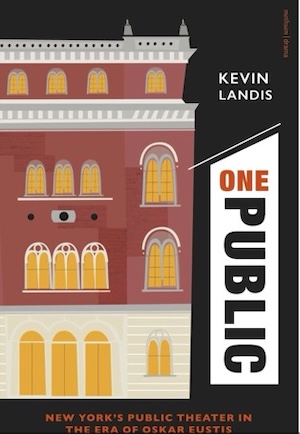
One Public
Landis, Kevin. One Public: New York’s Public Theater in the Era of Oskar Eustis. 2nd ed., Methuen Drama, 336 pp. ISBN 978-1350283459
Get the book →February 25, 2026
20260225-landis-kevin-one-public-new-york
A close-up
The rest of this thread

Kevin Landis
Kevin Landis is a professor of theatre in the Department of Visual and Performing Arts at the University of Colorado, Colorado Springs. His research interests range from contemporary avant-garde performance to Eastern European actor training, to performance analysis of evangelical church services to the theatrical intersections of food preparation. He co-authored Cultural Performance: New Perspectives on Performance Studies and is the author of One Public: New York’s Public Theater in the Era of Oskar Eustis.
Know something the rest of us don't?
Most threads on Rorotoko begin with our invitation. Some begin with a proposal. Both use the same prompts and the same editing, with your own pages in the archive. Proposed threads carry a small Sponsored label and a fee.
Propose a thread →