Chapter 3, ‘Loneliest tile’, tells about a remarkable breakthrough about tiling patterns, a collaboration between an enthusiastic (and highly talented) amateur and a small group of professionals. Most tiling patterns are repetitive, such as a grid of square or hexagonal tiles. A few decades ago Roger Penrose found some interesting tilings based on pentagons, which according to the orthodox study of crystals shouldn’t exist. The loophole that allows them to exist is that these tilings are not regular repetitions of the same arrangement — technically, they’re not periodic. They turned out to be important in crystallography, giving rise to a new type of material, a ‘quasicrystal’. One quote here sums it up: ‘One source of mathematical creativity is to break the rules. To do this honestly we have to leave ourselves some wiggle room, because we can’t disprove a theorem if it’s true. So what we actually do is change the game by modifying the rules.’
A natural question for mathematicians is: can there be a shape of tile that can cover an entire infinite plane, but can’t do so periodically? Such a shape would be balanced on a knife-edge between order and chaos, posing difficult problems for any mathematical analysis. Regular enough to understand, irregular enough to forbid periodic patterns. In 2022 these obstacles were overcome, with the discovery of the ‘hat’ tile by David Smith, and a proof that (a) it tiles the plane, and (b) it can’t tile it periodically. Right now this discovery has no serious applications, aside from unusual flooring, but the new methods involved could well lead to advances elsewhere.
Another, very different area that would be a good starting point is Chapter 6, ‘Best strategy’. How to win — or at least not lose— at various games.
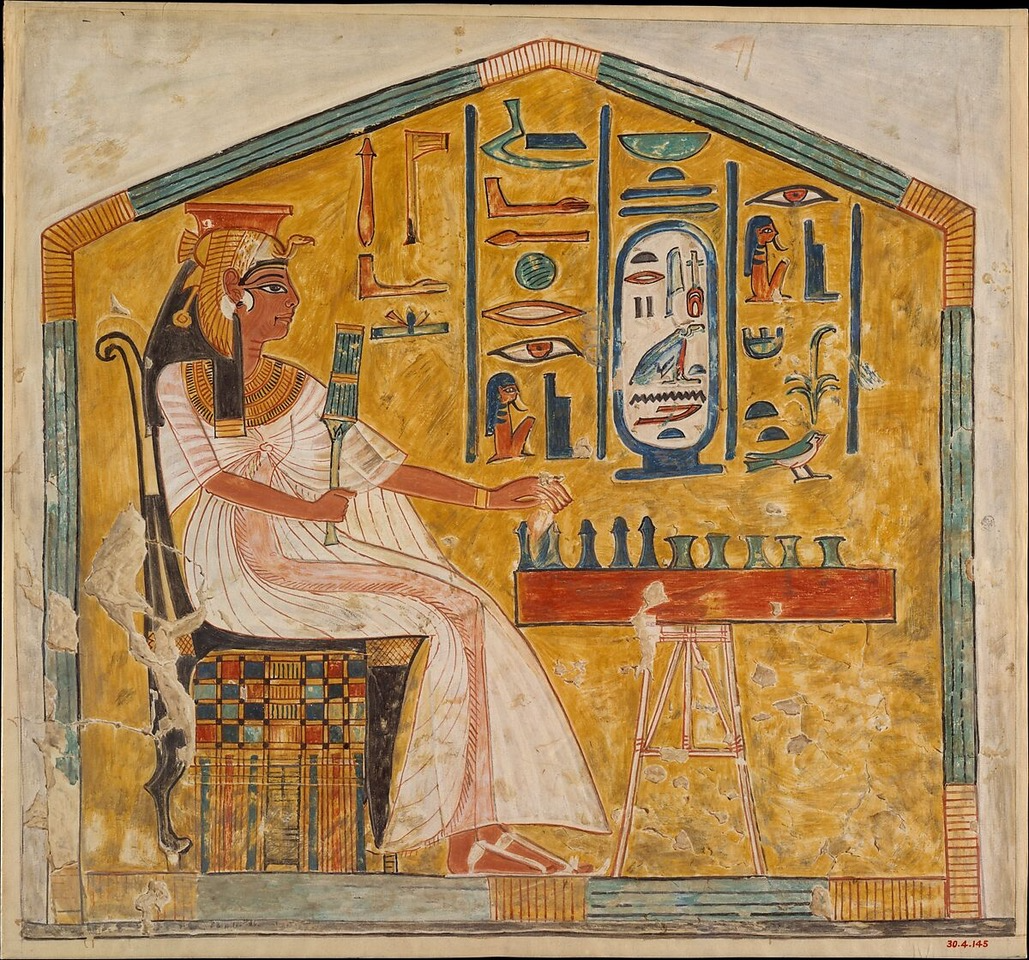
This starts in ancient Egypt with the board game senet. It moves on to John von Neumann’s ‘game theory’, using examples like rock-paper-scissors, the mating strategies of the common sideblotched lizard, and nuclear Armageddon. The story then shifts to Artificial Intelligence, and recent breakthroughs in computer chess and the oriental game of Go.
This led Go master Lee Sedol, number two in the world, to retire from professional Go, calling computers ‘an entity that cannot be defeated’.
I don’t have any particular hidden agenda in mind when I write a book. What my readers get out of it is their business. It’s a different experience for every individual. I’m not writing for the public to increase the amount of funding for the subject (as one prominent mathematician assumed about fifty years ago, apparently seeing no other reason for my profession to explain what it’s doing). I write what I think will interest readers; I try to make difficult ideas accessible; I want the reading experience to be pleasant, but not by being content-free. We all respond to challenges provided they’re within our ability.
First and foremost, I want readers to enjoy themselves. Not by ‘dumbing down’ mathematics; I don’t think that oversimplifying leads to anything worthwhile. To be frank, I tend to push my luck a bit by ‘dumbing up’. Telling the story as simply as I can, but including something readers can get their teeth into as well.
Next, I want to make it clear that mathematics didn’t die out centuries ago. Your school textbook didn’t contain all the mathematics there is, and the answers at the back of the book don’t solve everything. In a way it’s more important to realise that new mathematics is being created, with vital applications that affect all of us, than it is to understand precisely what new mathematics is being created.
Of course, that’s the third aim: to help readers gain insight into these novel breakthroughs and what they’re good for. Details matter (though not if they get technical). The interplay of ideas in today’s mathematics — and its relation to science, commerce, technology — is wonderful. But I’m not trying to teach readers anything. (If I want to do that, I write a proper textbook.) Just to give them insight.
The way to do that is to tell a good story. Mathematics is full of stories. Not just about its historical trajectory and the lives of the people who created it, though those stories are fun and show that mathematicians are human.
A mathematical proof is a type of story. It has a beginning (statement of the theorem), an end (QED), and a middle (the proof itself). The better the story, the better the proof.
I once wrote a paper rewriting part of Romeo and Juliet in the style of a computer program, and the nursery tale of The Three Little Pigs in the stilted style of many mathematics papers (let Pj = pig j for j = 1,2,3...). The aim was to demonstrate that both become unreadable. As a more respectable instance, Chapter 7 (fewest colours) describes how the Four Colour Problem for maps was solved, an epic tale with massive computer assistance analysing two thousand cases, each requiring huge, though routine, calculations. The reception by most of the mathematical community was strangely muted. There I write: ‘Mathematicians were hoping for a Shakespeare sonnet or a gripping bodice-ripper; what they got was a telephone directory.’
Above all, I’d like to have convinced my readers that mathematics is a vital, enormous, and rapidly growing area of human activity. That it’s not just dull, repetitive, boring ‘sums’. It’s creative, beautiful, wonderful, useful, and full of surprises. You don’t need to be an expert to appreciate those things.

.png)