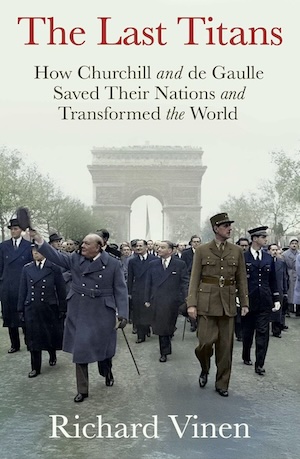
Both Churchill and de Gaulle are similar in the sense that they both emerge to their moment of apotheosis. Churchill has a kind of apotheosis in the Second World War. De Gaulle, people often think, has a moment of apotheosis in the Second World War, but in fact, he's the representative of a very small group in 1940. It's a kind of desperate stand on his part. He's a person who displays enormous courage, but he has very little power when he comes to London and raises the standard of French resistance in 1940.
The key difference between them in political terms is that de Gaulle, in the end, is the one thing that Churchill fails to be: a great peacetime leader. De Gaulle's moment of greatness is probably from 1958 until the late 1960s, when he is president of France, when he creates a new constitution, when he really completely remolds France. Churchill never has that kind of influence.
In some ways, de Gaulle would quite like to have been Churchill. He would have liked to be the heroic leader of a country fighting on against desperate odds, but he wasn't. And Churchill would quite like to have been de Gaulle — the man who remolded his country in peacetime — but he wasn't.
Their personal differences are just extraordinary. De Gaulle is very tall, socially awkward, quite cold, extraordinarily austere in his personal tastes. Churchill is short, very charming, not always entirely trustworthy, very fond of his comforts. Churchill's country house has a heated swimming pool, even though he can't really afford it. De Gaulle's first country house has no running hot water.
In that way, they’re very different men. There are ways in which de Gaulle looks quintessentially English — incorruptible, cold, not necessarily someone you'd like to sit next to at dinner — and Churchill looks like a quintessential French parliamentary politician: witty, charming, eloquent, but not entirely trustworthy.
Ongoing thread. More from Richard Vinen to follow.