
Scott Kurashige
American Peril
Most Americans go through their formal education learning very little or merely superficial things about Asian Americans. Popular culture and political discourse too often fills that vacuum with stereotypes and misinformation. This book, and my scholarship broadly speaking, situates Asian Americans into the history and politics of race, capitalism, and social movements in the United States with a focus on anti-Asian racism and violence.
During the COVID-19 pandemic, when Asian Americans comprised a significant number of health care workers and first responders working overtime to protect the public, a wave of anti-Asian hate incidents erupted ranging from name calling to physical violence. These incidents drew belated attention from the public and media, in large measure because the president and other prominent political figures were egging them on with xenophobic comments like “China virus” and “kung flu.”
What most shocked the nation was the mass murder of eight people, including six Asian women, in Atlanta area spas in March 2021. For many Americans, this was an introduction to anti-Asian violence. But there’s a longer history of anti-Asian violence stretching back over 175 years tied to white supremacy, colonialism, and misogyny.
This book provides irrefutable documentation of that violent history, but it also reveals how and why that history has been erased and covered up from both the official record and our mainstream textbooks.
Curator: Rachel Althof
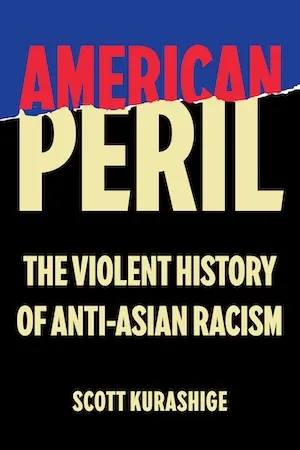
American Peril
Kurashige, Scott. American Peril: The Violent History of Anti-Asian Racism. University of California Press, 2026. 352 pp. ISBN 978-0520424777
Available here →April 18, 2026
20260418-scott-kurashige-american-peril
In a nutshell
The rest of this thread

© Jovelle Tamayo
Scott Kurashige
Scott Kurashige is President of the James and Grace Lee Boggs Foundation and the author of four prior books, including The Shifting Grounds of Race: Black and Japanese Americans in the Making of Multiethnic Los Angeles (recipient of awards from the Association for Asian American Studies and American Historical Association) and The Next American Revolution: Sustainable Activism for the Twenty-First Century with Grace Lee Boggs. He has held tenured faculty positions at University of Michigan, University of Washington Bothell, and TCU, and research fellowships at Harvard and the Smithsonian.
Pull this thread
pulls againstpulls alongside
Anti-Asian violence in America is a continuous 175-year pattern, and denying its racial motive is part of the pattern.
Against EA · Japanese colonial nostalgia for Korean folk culture turned it into the emblem of nationality for post-liberation Korea. On: The colonial relation is adequately described as domination and erasure of the colonized
Against JP · The Stalin cult was manufactured without a manufacturer, since no central cult institution could exist in a collectivist polity. On: National character is a real and durable explanatory factor
Against RE · The 1743 Memoirs of an Unfortunate Young Nobleman, reprinted as a novel, is substantially true. On: The reasons participants give for what they do are reliable evidence about why they do it
Against MO · West Africans controlled the terms of early modern trade on their own coast, including the trade in enslaved people. On: The colonial relation is adequately described as domination and erasure of the colonized
Alongside BS · African restitution claims began in 1965 and were defeated by European museum directors, so today's debate happened forty years ago. On: The colonial relation is adequately described as domination and erasure of the colonized
Alongside RI · The United States is an empire and aspired to be one from its origin, with liberty as its engine. On: National character is a real and durable explanatory factor
Alongside TW · Jazz history, told as a succession of God-like male heroes, enforces masculine and heterosexual norms. On: The reasons participants give for what they do are reliable evidence about why they do it
Alongside GO · The tropics are an invention of the temperate zone, and the pineapple's circuit falsifies the ranking they carry. On: The colonial relation is adequately described as domination and erasure of the colonized
Know something the rest of us don't?
Most threads on Rorotoko begin with our invitation. Any thread can begin with a proposal: you write it with the same prompts every thread answers, and we read it.
Propose a thread →