
Karen Bloom Gevirtz
The Apothecary’s Wife
We have inherited a lot from the seventeenth and eighteenth centuries, including newspapers, coffee shops, the stock market, and vaccines. Profit-based medicine is on this list. When people around the world argue about access to medical care – who gets it, who pays for it, what should be done (if anything) about inequities in the system, and so forth – they argue about a system that was made at a certain time by certain people with certain values and priorities and certain techniques for convincing everyone else. Medication-as-commodity is not an unavoidable fact of life, like gravity. The system can be adjusted to accommodate different values, such as national health care in countries that believe that the state should protect its citizens or privatized health care in countries that believe that the state should protect corporations.
The transformation of medicine from a communal, shared, domestic good into a private, individualized, commercial object was not my original topic when I started writing this book. I was researching the impact of the Scientific Revolution on ordinary women’s lives, and I was not questioning the Triumph of Science narrative. All that changed one morning in the basement of an English manor house. To my shock, when I opened Elizabeth Blackwell’s (1707-59) stunningly beautiful, massive two-volume set of medicinal plants entitled A Curious Herbal, I realized that as late as the 1730s, apothecaries and physicians saw ordinary housewives as competition: economic competition, no less. I could not fathom why the Royal College of Physicians and the Worshipful Society of Apothecaries would feel a need to sponsor a book that attacked housewives’ medical care. Didn’t everyone already know that medical doctors and their scientific medication was the best there was? More research not only answered the question (no, everyone most certainly did not already know that, thank you very much) but also showed that medical doctors made the same medications from the same ingredients using the same processes as women. Long before “scientifically made” medication became superior, people had come to believe that it was. It wasn’t a scientific transition. It was an economic one.
Furthermore, although it is convenient to describe it in terms of a Battle of the Sexes, the evidence is clear that battle lines were not so neatly drawn. Sure, proponents of professional medication (as an entity and as a system) tended to be men and proponents of domestic medication (as an entity and as a system) tended to be women, but it was hardly uniform. The Apothecary’s Wife draws on a huge range of materials to make the case for economic motives. Published poems, plays, treatises, novels, housekeeping manuals, gardening books, legislation, speeches, newspaper articles, and advertisements, to name a few types of text, show how pervasive the debate was and how it unfolded. The same for archival materials in which people speak for themselves, including recipe books, prescription collections, medical lectures, annotations in medical students’ notebooks, personal letters, housekeeping accounts, apothecary inventories, municipal records, and the like are full of evidence of a swift, comprehensive, economic and cultural transformation.
Ongoing thread. More from Karen Bloom Gevirtz to follow.
Curator: Kelli Garza
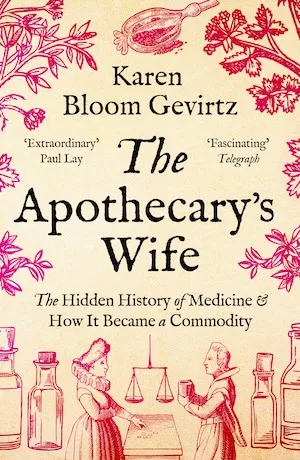
The Apothecary’s Wife
Gevirtz, Karen Bloom. The Apothecary’s Wife: The Hidden History of Medicine and How It Became a Commodity. Head of Zeus/University of California Press, 2025. ISBN 978-0520409910
Available here →April 23, 2026
20260423-karen-bloom-gevirtz-the-apothecarys-wife
The wide angle
The rest of this thread

Karen Bloom Gevirtz
After nearly thirty years as professor of English, Gender Studies, and Medical Humanities, Karen Bloom Gevirtz left academia and became an independent scholar. She received her BA from Brown University, where she was pre-med and assisted in a neurochemistry lab, and her PhD from Emory University. Internationally recognized for her scholarship on women and writing in seventeenth- and eighteenth-century Britain, she has been awarded grants and fellowships for her at home and abroad. The Apothecary’s Wife was long listed for the inaugural Procedure Award, and is one of Kirkus Review’s Best Nonfiction Books of 2024.
Pull this thread
Medicine became unaffordable by economic decision when physicians and apothecaries supplanted women's free domestic medicine.
Know something the rest of us don't?
Most threads on Rorotoko begin with our invitation. Any thread can begin with a proposal: you write it with the same prompts every thread answers, and we review it.
Propose a thread →