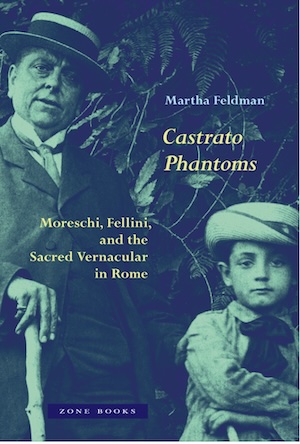
Castrato Phantoms traces the afterlives of the storied founders of bel canto singing. Turning to the last castrato Alessandro Moreschi (1858-2022) and his forebears and descendants in Rome, the book constructs a nonlinear history of the castrato phenomenon at its end stages, including their reverberations across the twentieth century, showing that castrati were always embedded in the secreted and the untold. Here the “secreted and untold” refers to numerous forms of concealment: about how castrati (plural) were chosen (by agents, churchmen, and patrons), how they were made (by surgeons), and how they ended up removed from families, installed in church schools, and displayed in chapels and salons; but also the ways their tales were bracketed in family histories and suppressed in Roman discourse and consciousness.
Castrati, I argue, assumed the function of a latency that haunted Moreschi and his predecessors, especially after about 1830. By then, they had departed from European opera stages and soon ended up exclusively in papal Rome. Since then, castrati have continued haunting our present, whether in the machinic and mediatized forms of shellac and vinyl records, CDs, streaming sites, websites, monographs, fanzines, and iconographies or in the human form of high-voiced male countertenors or cross-dressed female mezzos.
Notably, this haunting operates within a culture that is not just pervaded by the sacred—including castrati, who are both abjected and revered, and are thus set apart as a sacred beings—but is constantly domesticating and naturalizing the sacred through an emphatically Roman tropology that I call the “sacred vernacular.” In my analysis, the sacred vernacular quickly leads us to the most iconic of Roman filmmakers, Federico Fellini, who, I show, is also a relative by marriage of Moreschi’s. Fellini’s early films through the 1950s, up to and including the 1960 film that rocketed him to international stature, La dolce vita, are littered with angels, rosaries, incense, crucifixes, confessionals, churchly vestments, and Catholic rituals. Participating in these rituals, Fellini’s famous actress wife Giulietta Masina turns out to have been very close to and protective of their niece Rita Fellini, who was also the castrato’s great granddaughter—a genealogical connection the book assembles from the slenderest of leads.
Ongoing thread. More from Martha Feldman to follow.