
As an author, I would recommend that the reader go through the book from cover to cover. The “Table of Contents” should be the first page one should read and ponder why the authors used idiosyncratic titles for the chapters of this book, and not classical ones, which are the norm for history books. Why did they not use classical titles, like “Enver Hoxha and the Soviet Union, 1949-1961,” “Hoxha and Tito, 1945-1948,” or “Hoxha and Mao, 1961-1976”?
We chose, instead, metaphors as titles for this book’s chapters. They encapsulate the challenges Hoxha faced to his power and the goals he set for himself. They are tropes that serve as entry points for reading the chapters and keywords for decoding them. If titles are read carefully and in order from the first to the last chapter, the reader will be able to understand Enver Hoxha’s transformation across time: from a failed student to the last years of his life, when, while an undisputable leader, he executed and jailed the bulk of his old comrades who had stood by him throughout the stormy life as commander in chief. Dictators are historical characters and subjects.
They change across time in an intimate dialogue with the broader transformation that the world around them goes through. This is the message the reader should get at first glance on the “Table of Contents.” There is another reason why we avoided classical history titles. Had we done that, then Enver Hoxha’s story would have become a local one, thus narrowing the scope of the investigation to the alleged traits of his character. This is the trap many other previous biographies of him have fallen into. We rather wanted to contextualize and situate him in space and time, without giving precedence to any of these categories. Indeed, it is hard to really talk about genuine local stories in the 20th century.
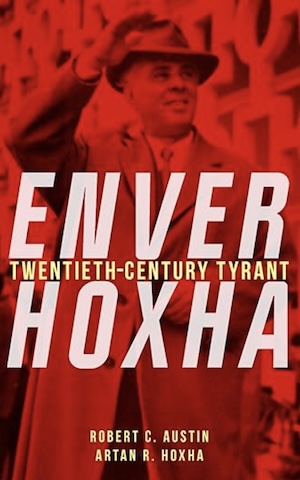
It is hard to find individual lives that have not been affected in one way or another by the great upheavals of the 1900s. We made our position on this issue visible in the title by identifying him as “A Twentieth Century Tyrant.” With this book, we tell a much bigger story. It is a story of the last century and the ruins it has left behind, of social, economic, intellectual, cultural, and, above all, human consequences that will be with us for a while into the future. Among scholars of Southeast Europe, it has been discussed for some time now to globalize the history of the Balkans.
This book, which pursues the traces of my other book Sugarland: The Transformation of the Countryside in Communist Albania, is an answer to this need. It provides the scholarly community and the interested readers with a template to grasp the history of this part of Europe from a perspective that transgresses parochialism and essentialism. While not denying regional specificities, the book considers Hoxha as an actor who staged a global tragedy of his era at the local scene.
This book recounts a tragic and timeless dimension of human experiences, which should not be forgotten but remembered as a warning call for the future. Let’s not forget that tyrannies have been a main subject of concern since the time of ancient Greeks, who knew both democratically elected leaders and tyrants who destroyed freedom for the sake of their own unconstrained power. The study of tyranny has been tightly tied to its antithesis, e.g., freedom. Hoxha’s biography assesses how fragile freedom is and how it is attacked both on the left and on the right. Let’s not forget this, as well.
As I am writing these lines, there is an increasing hype about Marxism. Those who support it, while speaking of humanism, show an irritating neglect of the experience Eastern Europeans have gone through.
It is just another instance of Orientalizing the people of this part of the world. Following this logic, if the Marxist experiment went wrong, this was due to Eastern or Southeastern Europeans. The spectacular collapse of the communist regimes does not prove much to Marx’s contemporary followers. Since it took place in the less developed part of Europe, it does not prove that there is something fundamentally wrong with Marxism. The lessons from these countries have only a limited regional value, and there is nothing universal we can learn from them.
This dismissive behavior from Western Marxists diminishes the importance of the lessons that can be retrieved from the half-century of extreme-left dictatorships. Ideologies that neglect human historical experiences and achievements, which create entire groups of enemies, preach class-struggle as the engine of history, and that impose intellectual categories and ideal-types that men fail to meet, give birth to tyrants and set the stage for political systems commanded by hyper-centralized dictatorships. This book shows exactly this story, of the metamorphosis Enver Hoxha underwent: from a materialist and pragmatist dictator who wanted to modernize his country, he became a dogmatic tyrant, blind to his people’s suffering, obsessed with pursuing at all costs ideological purity.
Of course, the majority of normal people who happened to live under these tyrannies tried to have a normal life and fill it as much as possible with mundane pleasures. Despite the efforts of the regimes to permeate all spheres of life with the monistic ideology, only a few took it seriously, while the appeal of capitalism and liberal democracy only kept growing. The reaction from below shows the limits of the Platonian dream of philosophers, which seeks to “rationally” govern society while ignoring the latter’s needs. It also shows the value of diversity of ideas, with plurality not reduced to external markers conceived in academia or political laboratories. History, as a field of knowledge, investigates what links the past to the present and the future. Historians’ duty is to bring to the fore the lessons we have accumulated from what we have gone through and use them as a light for our common march into the future. This book serves this purpose.

.png)