
In a nutshell
May 9, 2026
The Virtual Universe
With this book, I aim to offer a holistic perspective on what virtual worlds and the Metaverse are, what they are not, and what they may become. Much of the debate lacks this balance. It tends to swing between utopian visions, what I call the “Petaverse” to highlight all the Possibilities of virtual worlds, and dystopian narratives, where the Metaverse is framed as a “Metaworse,” emphasizing its risks and downsides. What is often missing is a more nuanced perspective that brings together different topics and viewpoints.
This is precisely what The Virtual Universe seeks to provide. It connects economics, technology, and ethics, while also exploring practical implications for business functions such as marketing, human resources, and supply chain management. At the same time, it looks beyond the corporate world to broader fields such as education, healthcare, and sustainability.
The book addresses a wide range of questions. It traces the evolution of virtual worlds, from early forms of virtual reality to today’s and tomorrow’s Metaverse. It explores the underlying technologies, including Artificial intelligence, Blockchain, and Cloud computing, the Metaverse’s tech “ABC.” It examines virtual economies and business models, and how they interact with the real world. It also discusses ownership, virtual assets, currencies, and income, as well as key ethical and regulatory issues such as data protection, privacy, and responsible behavior in virtual environments.
To bring these ideas to life, the book includes a series of case studies, ranging from Paris Fashion Week and platforms like Roblox and Fortnite to companies such as BMW and institutions like IE University, with a particular focus on how higher education and business schools are using virtual worlds.
At its core, the book aims to offer a clear, simple, and memorable definition of the Metaverse as “an immersive, independent, and interconnected virtual social universe.” Immersion refers to the degree to which users are fully engaged in a virtual environment, ideally to the point where the boundary between physical and virtual reality fades. Independence captures the idea of decentralization, where no single entity controls the virtual space. Interconnection reflects a future in which virtual worlds operate like the internet, allowing users to move seamlessly between them with their avatars, assets, and data.
Today, none of these dimensions is fully realized. This, in itself, is perhaps the most important insight: the true Metaverse has not yet arrived.
Ongoing thread. More from Andreas Kaplan to follow.
Curator: Bora Pajo
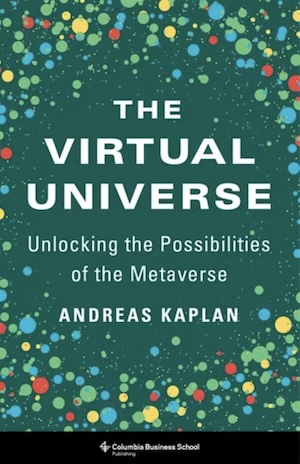
The Virtual Universe
Andreas Kaplan, The Virtual Universe: Unlocking the Possibilities of the Metaverse. Columbia University Press, 2026. ISBN 9780231561853
Get the book →May 9, 2026
20260509-andreas-kaplan-virtual-universe
The rest of this thread

Andreas Kaplan
Professor Andreas Kaplan is an internationally renowned futurist and a leading authority on digital transformation and disruptive innovation. His expertise spans artificial intelligence, social media, and virtual reality, with a pioneering track record in virtual worlds and the Metaverse dating back to the early 2000s. Widely recognized as one of the most cited and influential academics in his field, Dr. Kaplan is a sought-after advisor to organizations and a frequent speaker at high-profile global events. His work has been published by some of the world’s most prestigious academic presses, including Cambridge, Columbia, Harvard, and Oxford University Press.
Feature your book, your art, your project
Publishing with a small press, or on your own?
A Sponsored Thread runs like every other thread on Rorotoko: three parts on three dates, the same editorial review, your own pages in the archive. Marked Sponsored. $199, paid only once accepted.
Get featured →