
A close-up
May 18, 2026
Experiencing Reality
Along the beaches of Northern Ireland’s Causeway Coast, the sand is never still. Sculpted by restless winds and turbulent tides, one moment it lies smooth, the next it ripples into resistance: ceaselessly shifting between states of calm and conflict.
As a child growing up just outside Carrickfergus, these beaches became a playground. When cousins visited from England, our parents and grandparents would bring us to White Park Bay to run wild across the dunes, our laughter lost to the wind. Years later, as an adult - and now a designer - my strolls along these shores became calmer moments of observation and reflection. I began to look more closely at the patterns beneath my feet and wondered how the language of the beach might be translated into form.
This question eventually led to the Dune Tableware Collection. Spanning four sculptural showpieces - a chess set, bowl, vase and candelabra - each object distils the sands of the north coast into a unique tactile experience.
.jpg)
The collection began with the chess set, where the two opposing sides are differentiated by surface texture: one smooth, the other rough. The board arises as a gently undulating landscape, allowing play to unfold across a miniature dune field shaped by the same forces that sculpt the beaches of the north coast.
The remaining objects translate these ideas into sculptural vessels. In elevation, each piece tapers subtly at the waist, as though its mass has been drawn upward by the wind. In plan, the vase, bowl and candelabra share a tripartite fused-circle footprint; a subtle reference to the continuous Celtic knot patterns historically carved into ancient Irish stonework.
.jpg)
At a time when our sense of touch is increasingly defined by jabbing at keyboards and swiping across screens, I wanted to design objects that invite physical engagement. The desire to work with a granular material capable of capturing both visual intricacy and tactile richness led me to ceramic sand 3D printing.
The result are expressive monolithic pieces rooted in place and responding to human experience. This fusion of digital precision and geological inspiration demonstrates how technology and craft can merge to deepen our physical relationship with objects.
As an architect these works act as material, formal, and atmospheric experiments; a way to test ideas at an intimate scale while gradually building a studio practice. As my design vocabulary evolves, I plan to expand these explorations into lighting, furniture, interiors and eventually architecture.
.jpg)
If digital tools now recede into the background of design, the real challenge is how we use them to rediscover the richness of the physical world. In that sense, the dunes of the north coast remain my quiet collaborators; endlessly reshaping the ground beneath my feet and reminding me that the role of design is not to escape reality, but to help us experience it more deeply.
To learn more about Rory’s work you can visit his studio’s website: www.nobleturnerdesign.com or follow his work on Instagram: @nobleturnerdesign
Curator: Bora Pajo
Experiencing Reality
Get the book →May 18, 2026
20260518-rory-noble-turner-experiencing-reality
The rest of this thread
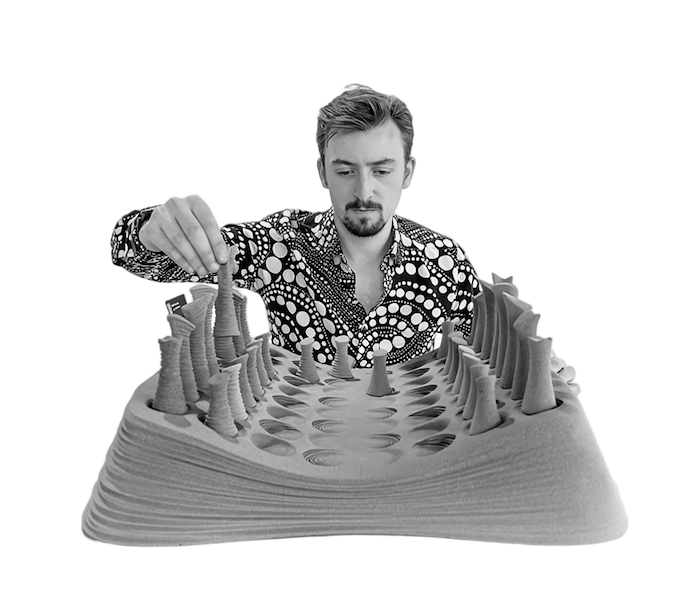
Rory Noble-Turner
Rory Noble-Turner is a Northern-Irish architect and designer whose practice explores material tactility and atmospheric experience through post-digital craft. Drawing on the cultural and geological landscapes of his native roots, Rory’s work is shaped by an earthy elegance; grounded in moments of human connection and inspired by the quiet drama of unfolding natural forces. Guided by a philosophy of Post-Digital Humanism, Rory uses contemporary tools to deepen our physical and emotional engagement with the everyday world. He is a regular guest design critic at several London universities and an AI & Digital Design Mentor with the Monday.com Tech School Foundation. To learn more about Rory’s work you can visit his studio’s website: www.nobleturnerdesign.com or follow his work on Instagram: @nobleturnerdesign
Propose a thread
Know something the rest of us don't?
Most threads on Rorotoko begin with our invitation. Some begin with a proposal. Both use the same prompts and the same editing, with your own pages in the archive. Proposed threads carry a small Sponsored label and a fee.
Propose a thread →