
Deana L. Weibel
The Ultraview Effect
I’m an anthropologist of religion who married a space historian and gradually found myself drawn into his world and his community’s way of thinking. Through my husband, Glen E. Swanson, I met and interviewed an astronaut for the first time, and what struck me immediately was how much this particular astronaut’s perspective as an evangelical Christian shaped the way he understood his experience in space. As I went on to meet and interview more astronauts and others in the space community, I began to notice that many (though certainly not all) were deeply religious, and that religion could play a role both in motivating space exploration and in shaping how people interpreted what they encountered there. And I saw that space exploration could also modify religious beliefs in interesting ways.
At the same time, I was aware of earlier work on the “overview effect,” the psychological shift astronauts often describe when they look back at Earth from space. That idea has been incredibly important. But what I started to notice was something related, perhaps equally awe-inspiring but more disorienting than clarifying. What I call the “ultraview effect” is much rarer than the overview effect. It happens only when astronauts become fully dark-adapted and look out into the stars. Instead of focusing on Earth, they’re confronted with the vastness of everything beyond it. People describe a kind of visceral awareness of how little we know about the universe we inhabit. It’s another form of the sublime, but one that tends to produce a very different kind of realization. I saw later that space scientists experience a version of the ultraview effect from thinking about space, but the astronaut experience of it is much faster and more physical.
That’s part of what makes this moment in space exploration so interesting. With the Artemis missions, astronauts returning to the Moon may have greater opportunities to experience true darkness, far from the reflected light of Earth. I find myself wondering what it will mean for people to look out into a sky so full of stars that constellations disappear, and how that might reshape their sense of reality and of themselves.
Curator: Kelli Garza
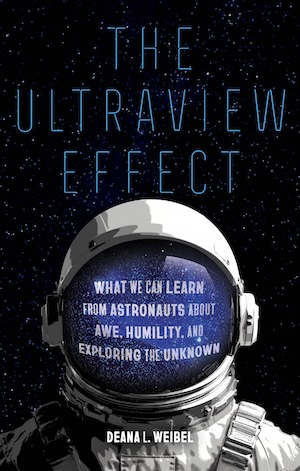
The Ultraview Effect
Weibel, Deana L. The Ultraview Effect: What We Can Learn from Astronauts About Awe, Humility, and Exploring the Unknown. University of California Press, 240 pages, 5 x 8 inches, ISBN: 9780520409521
Get the book →May 21, 2026
20260521-deana-weibel-the-ultraview-effect
The wide angle
The rest of this thread

Deana L. Weibel
Deana L. Weibel is a Professor of Anthropology at Grand Valley State University in Michigan. She studies the human side of space exploration, focusing on how astronauts and other members of the larger space community make sense of their “unearthly” understandings and experiences. Her work draws on the anthropology of religion and explores themes like awe, spirituality, and encounters with the unknown. She has published in both academic and public venues and is a Fellow of The Explorers Club.
Know something the rest of us don't?
Most threads on Rorotoko begin with our invitation. Some begin with a proposal. Both use the same prompts and the same editing, with your own pages in the archive. Proposed threads carry a small Sponsored label and a fee.
Propose a thread →