
Doron Zeilberger
Ultrafinitism
1) What is ultrafinitism — what do you actually reject, and what do you keep?
The belief that both the physical and the mathematical universes are finite. Of course, they are enourmously large, but still finite. The so-called infinity is completely unnecessary, and is due to a superstitious belief in something transcendental, analogous to the belief in God. For some people it is a useful and conforming fiction, and may have done some good, (both the belief in God and the belief in a mathematical infinity), but this does not change the fact that infinity is definitely fictional (and unnecessary). Whether God does or does not exist is an open question, and is unknowable, but if God exists, he (or she, or it) is a finite God.
2) What's the everyday cost of putting infinity at the foundation of mathematics — what does it break, distort, or hide that most mathematicians don't notice?
One would have to rewrite the standard math textbook in the new language. There is a simple "transform" that lets you translate anything spoken with infinity in a way that does not mention it. Since we know that is is possible, it is easier to keep the textbook the way thery are, adding a footnote, that the infinity is really "infinity" (a finite symbol).
3) Could you take one piece of mathematics and show us concretely how an ultrafinitist does it differently?
The derivative of x2 is usually computed as folllows
(x2)' = limh→0 ((x+h)2 − x2) / h
= limh→0 (x2 + 2xh + h2 − x2) / h
= limh→0 (2xh + h2) / h
= limh→0 (h(2x + h)) / h
= limh→0 (2x + h)
= 2x
Here is the correct way. Let h be the "mathematical Planck constant", a tiny but NOT zero, "smallest distance"
(x2)' = ((x+h)2 − x2) / h
= (x2 + 2xh + h2 − x2) / h
= (2xh + h2) / h
= (h(2x + h)) / h
= 2x + h
So the derivative of x2 is NOT 2x, but 2x+h. Since h is SO tiny, we can replace it by 0 for all applications.
4) You keep a numbered list of 195 Opinions on your website. Pick the one you think a ROROTOKO reader should read.
Curator: Bora Pajo
Ultrafinitism
Available here →June 9, 2026
20260609-doron-zeilberger-ultrafinism
In a nutshell
The rest of this thread
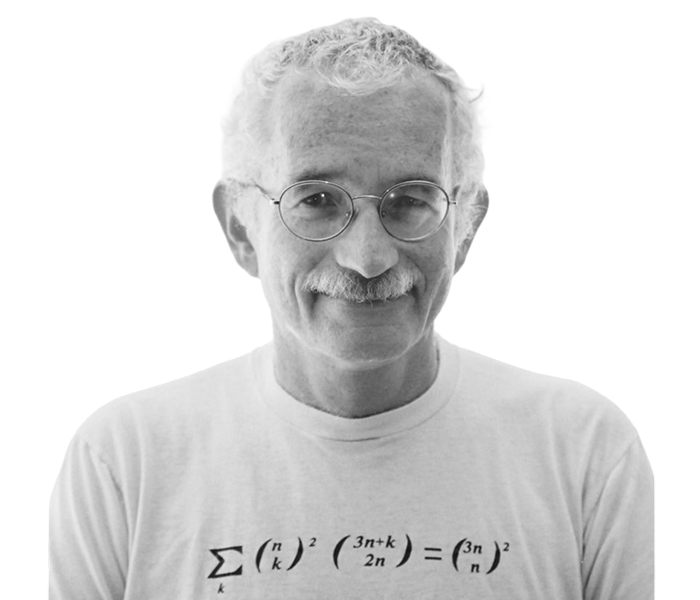
Doron Zeilberger
Doron Zeilberger is a Board of Governors Professor of Mathematics at Rutgers University. He received his doctorate from the Weizmann Institute of Science in 1976 under Harry Dym.
Zeilberger is known for major contributions to combinatorics, hypergeometric identities, and q-series, including the first proof of the alternating sign matrix conjecture and later work on the q-TSPP conjecture. With Herbert Wilf, he developed WZ theory, a landmark approach to hypergeometric summation. He is also known for his strong advocacy of computer-assisted mathematics, often crediting his computer “Shalosh B. Ekhad” as a co-author.
His honors include the Lester R. Ford Award, the AMS Leroy P. Steele Prize, the Euler Medal, the AMS David P. Robbins Prize, and election as a Fellow of the American Mathematical Society.
Pull this thread
Infinity is a fiction, and the mathematical universe is finite.
Know something the rest of us don't?
Most threads on Rorotoko begin with our invitation. Any thread can begin with a proposal: you write it with the same prompts every thread answers, and we review it.
Propose a thread →