
Paulina Rowińska
Mathematics and Creativity
I think we end learning mathematics at school at maybe 18th or 19th century. What other science is taught this way? It gives the impression that we know everything about math by the end of high school. Right now I'm working as a math journalist, and every single day I get new papers to write about. So there's just a lot of undiscovered stuff—new mathematics. But that is not taught in schools.
When I go to a restaurant, and we have to split the bill, people are like, “you're the math person”. I don't know how to count in my head. I haven't seen numbers in years, or done anything with numbers in years. Because that's the thing, we learn calculus. By learning calculus, people mean they know how to compute integrals. No mathematician ever computes integrals. It's good to know, but it's kind of a skill. It's as if you were teaching me foreign language by giving me a dictionary and now we learn everything starting with letter ‘B.’ Yes, you need to know words, but we also need to know how to use them, and why we are learning them. Are you learning a language to watch a movie, or read a book, or maybe you are traveling to a country, or maybe your spouse is from that country. Everyone has different motivations.
But with math, it seems like you're just learning to pass the exam. I'm not saying that these skills are not important, because they are. Also, not that we have to suddenly teach students super advanced new math, but it's more to kind of give ideas and maybe have 40 minutes of the lesson doing the skills, but 10 minutes of the lesson thinking about why they're cool, or what's next. Honestly, when I went to university to study math, I did not expect what I would find there at all. It had nothing to do with high school math. I just sat there wondering if it was the correct lecture. It's just so different.
I don't even know if there is another more creative science. Whenever I read some big, or even small proofs of theorems, I wonder how did people come up with that? You have a theorem, we know an area of math, but they use tools from a completely disconnected area of math, because they kind of work this way, and if this is not creativity, then what is?
There's no other science without math. A lot of sciences these days are modeling, describing real world with mathematical language. You just need to know the basics of this mathematical language, and also you analyze data, and data analysis is all about math. People right now are all about AI. Well, AI is math. Even when you think about analyzing literature, we have mathematicians doing that. Math is everywhere.
Curator: Bora Pajo
Mathematics and Creativity
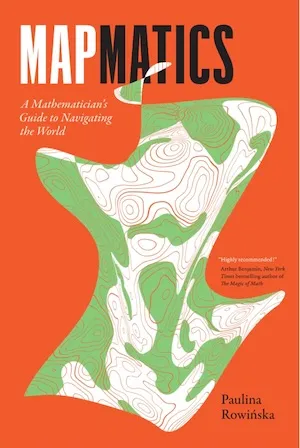
Rowińska, Paulina. Mapmatics: A Mathematician’s Guide to Navigating the World. Belknap Press of Harvard University Press, 304 page, 6 x 9 inches, ISBN: 9780674294233
Available here →June 10, 2026
20260610-paulina-rowinska-mapmatics
The wide angle
The rest of this thread

Paulina Rowińska
Paulina Rowińska is a science writer and journalist whose work has appeared in Smithsonian Magazine, Undark, and Quanta Magazine, among others. She holds a Ph.D. in mathematics from Imperial College London. Her popular science book Mapmatics received the Austrian Wissenschaftsbuch des Jahres (Science Book of the Year) award and has been translated into multiple languages.
Pull this thread
School mathematics stops centuries ago and leaves students believing the subject is finished.
Know something the rest of us don't?
Most threads on Rorotoko begin with our invitation. Any thread can begin with a proposal: you write it with the same prompts every thread answers, and we review it.
Propose a thread →