
Lee Albert Hill
Work Looks Back
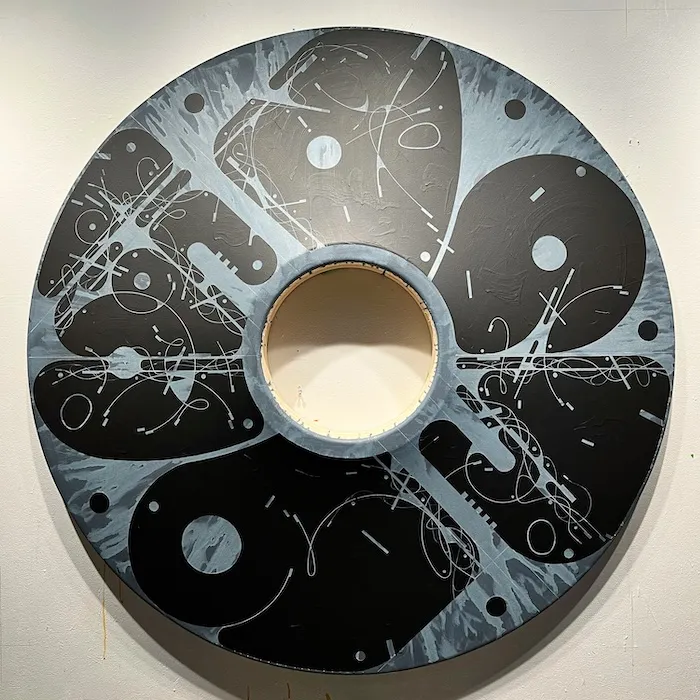
It didn’t read as an object in the usual way. It was more like a condition—light, accumulation, atmosphere. At first, it felt almost immaterial, like there wasn’t much to hold onto. But the longer I stood there, the more precise it became. The edges weren’t really edges, the surface wasn’t fixed, and depth kept shifting depending on how I looked.
What struck me was how intentional it was without feeling overdetermined. It wasn’t telling me what to see, but it was clearly structuring how I was seeing. My attention slowed down. I started to notice small shifts—density, brightness, the way the piece seemed to gather and disperse at the same time.
That moment stayed with me because it made something clear: the work wasn’t just there to be looked at—it was built with an awareness of the viewer. It anticipated that kind of sustained attention. In a way, it felt like it was looking back—not literally, but through how precisely it held me in place.
That’s something I’ve carried into my own work. The intention isn’t just in the composition itself, but in how that composition will be encountered. The work isn’t complete until that exchange happens.
What I hope my work invites is a similar shift—where looking slows down and becomes more deliberate. Not to arrive at a single reading, but to stay with the experience of seeing as something active, something that’s being shaped in real time.
A work is built through a set of formal relationships—proportion, alignment, adjacency, interval—but those relationships don’t settle into a single reading. Edges register, then slip. Intervals hold, then open. The composition remains slightly in play.
The work is fully intentional but not fully resolved. It anticipates the viewer. It’s structured with the awareness that it will be seen, that its relationships will be tested in real time. In that sense, it doesn’t simply receive attention—it returns it. It looks back.
That reciprocity is central. The viewer isn’t outside the work; they’re implicated in it. Looking becomes part of the structure itself.
What I hope the work does is make that condition felt—that seeing is not one-directional, but relational. The work holds its form, but it also holds the viewer within it, just long enough for that awareness to register.
Curator: Bora Pajo
Work Looks Back
Available here →June 11, 2026
20260611-lee-albert-hill-work-looks-back
The wide angle
The rest of this thread
Lee Albert Hill
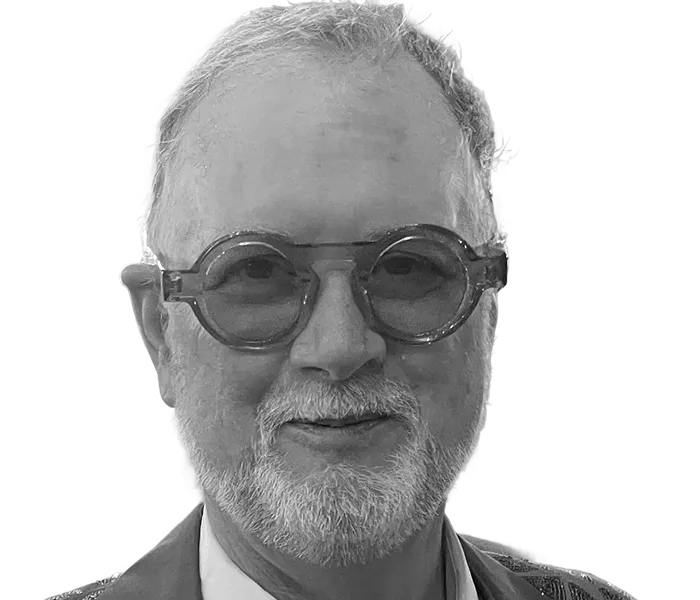
Lee Albert Hill is a Texas-based multidisciplinary artist, architect, and writer whose work engages visual art, spatial thinking, and cultural inquiry. From his Fort Worth studio, where he has worked for more than twenty-five years, Hill brings an architectural sensibility to painting shaped by four decades as a registered architect after graduating from the Texas Tech University School of Architecture. Since 2000, he has pursued a dedicated studio art practice and has contributed as a freelance writer for Texas Architect magazine. Hill is represented by the William Campbell Gallery in Fort Worth, a cornerstone of contemporary art in Texas since 1974. His work is held in public and corporate collections, including the Longview Museum of Fine Arts, the San Angelo Museum of Fine Arts, American Airlines, Dublin’s TIFCO Hotel Group, and SAMTX Investments in Austin, as well as in numerous private collections throughout Texas, California, Colorado, New York, and New Mexico.
Pull this thread
A painting is not finished until someone looks at it.
Know something the rest of us don't?
Most threads on Rorotoko begin with our invitation. Any thread can begin with a proposal: you write it with the same prompts every thread answers, and we review it.
Propose a thread →