
Robert J. Sampson
Marked by Time
I open the book with two children from our long-term study, Darnell and Andre, who at first glance seemed destined to lead similar lives. They grew up in the same city, at the same poverty level, with similar family and neighborhood backgrounds. Yet they held very different tickets in the birth lottery of history. Andre was born in the early 1980s; Darnell in the mid-1990s. Though alike in background, they came of age in different social worlds.
Andre’s cohort grew up amid the rise of drug-related violence. They became teenagers during the murder epidemic of the early 1990s and lived through rising incarceration and aggressive drug policing. By contrast, violence had plummeted when children born in the mid-1990s entered adolescence, and drug arrests fell by roughly 90 percent between 1995 and 2020. Darnell’s cohort was fortunate in other ways as well. Lead exposure, which is known to impair child development, declined sharply. By the time they turned 25, incarceration had dropped to its lowest point in more than a quarter century.
These two individuals capture the story of their birth cohorts. By age 20, youth born in the mid-1990s were arrested at about half the rate of youth born just a decade earlier, in the early to mid-1980s. The younger cohorts were also less likely to witness gun violence or to use guns as adults.
These cohort inequalities were not explained by race, family structure, poverty, self-control, or a host of other factors. Large-scale social change, not the usual suspects, distinguished the life trajectories of Andre’s and Darnell’s cohorts.
Another surprising finding is that the decline in arrest rates between cohorts was strongest for the most disadvantaged young people, particularly poor Black youth. Even among the poorest children, things got much better. That runs against the familiar narrative of unbroken societal decline.
My hope is that readers will come to see social change—and the unfolding of our lives—in a new and more constructive way. Rather than fixating on predicting individual criminality or a supposed criminal character, we should focus on building the institutions and environments that prevent crime and help us meet the unexpected challenges that the future will bring. Backed by long-term data, Marked by Time presents a vision for what it might mean to build such a future.
Curator: Bora Pajo
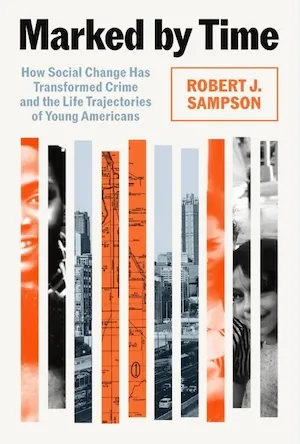
Marked by Time
Sampson, Robert J. Marked by Time: How Social Change Has Transformed Crime and the Life Trajectories of Young Americans. Belknap Press, 288 pages, 6 x 9 inches, ISBN: 9780674987548
Available here →June 2, 2026
20260612-sampson-robert-j-marked-by-time
A close-up
The rest of this thread

© Niles Singer/Harvard University
Robert J. Sampson
Robert J. Sampson is the Woodford L. and Ann A. Flowers University Professor at Harvard University. He is an elected member of the National Academy of Sciences, Fellow of the American Academy of Arts and Sciences, and a Corresponding Fellow of the British Academy. He is a recipient of the Stockholm Prize in Criminology and author of three award-winning books and numerous articles on crime, violence, the life course, urban inequality, and the changing social structure of cities.
Pull this thread
pulls againstpulls alongside
When you are born matters more than who you are, and history is baked into criminal records.
Against WM · Underinvestment in higher education, not trade, is why middle-class real earnings have been flat or falling since 1980. On: Quantified performance measurement improves the institutions that adopt it
Against DD · A large dealer bank fails by one mechanical sequence, a run by its overnight lenders, whatever caused the crisis. On: Social and economic phenomena can be modelled well enough to forecast them
Against TH · Ordinary crime control, not ideology, was one of the decisive steps to the Bolshevik totalitarian state. On: Rates of violence are set by material conditions such as poverty and unemployment
Against RA · Many undergraduates show no measurable gain in critical thinking because they are not asked to read or write much. On: Quantified performance measurement improves the institutions that adopt it
Alongside KA · The lie detector has survived eighty years of scientific refutation because it was never science. On: Quantified performance measurement improves the institutions that adopt it
Alongside FM · Computers transformed American politics through databases and direct mail, and the spectacular simulation ventures are the footnote. On: Social and economic phenomena can be modelled well enough to forecast them
Alongside HR · Wounded Knee happened because control of the U.S. Senate hung on one contested South Dakota seat. On: Rates of violence are set by material conditions such as poverty and unemployment
Alongside JW · Guizhou's educational miracle is literally fabricated, with doctored rosters, borrowed students and migrant workers seated as one-day pupils. On: Quantified performance measurement improves the institutions that adopt it
Know something the rest of us don't?
Most threads on Rorotoko begin with our invitation. Any thread can begin with a proposal: you write it with the same prompts every thread answers, and we review it.
Propose a thread →