
Ayşehan Jülide Etem
Film Diplomacy: A Media History of Turkey-US Relations
In 2016, in a library basement in Bloomington, Indiana, I opened a film canister labeled "Turkey." Then I opened another. And another. By the end of that day, I had found twenty-four 16mm educational films about Turkey and the Middle East, made between the 1950s and the 1980s, sitting in a Midwestern archive thousands of miles from the places they claimed to explain.
Nearby were boxes of evaluation forms. American librarians had watched the films and evaluated whether they were informative enough for classrooms. They made one problem impossible to avoid, usefulness always belongs to someone. A film called useful by one institution may be patronizing, strategic, or absurd from another position.
Those archival findings shaped the method of the book.
I followed films as physical objects, technologies, and institutional events. I worked through archives in Turkey, the United States, and beyond. I read government records, missionary correspondence, UNESCO reports, US Information Service film catalogs, policy memos, audience surveys, magazines, teaching guides, film scripts, and production documents. I watched films that survived in archives and films that survived only in low-resolution digital transfers. I also tracked titles that may no longer exist.
The research forced me to build across fields that often remain separate including film and media studies, public diplomacy, Middle East history, Cold War studies, American studies, communication studies, audience research, and critical whiteness studies. That combination became necessary because the films moved across those domains. A single reel could belong to education, religion, propaganda, foreign policy, development, and domestic governance at the same time.
The usual language of "soft power" and "propaganda" could not account for what I found. Soft power makes influence sound too smooth. Propaganda makes audiences sound too passive. The archive showed collaboration, misrecognition, censorship, translation, adaptation, and negotiation. It showed power, but power with paperwork, funding problems, institutional rivalries, local improvisations, and unexpected feedback.
Missionaries form the earlier layer of this story. American Protestant missionaries in Turkey used film in schools, churches, hospitals, prisons, and villages. They screened science films, agricultural films, health films, Disney films, and religious films. They often presented these screenings as educational. Film allowed them to align Christianity with modernity in a secularizing republic where overt religious messaging could trigger suspicion.
US government agents later built on related infrastructures. During the Cold War, the US Information Service used educational films to promote the American way of life, free-market capitalism, anticommunism, agricultural productivity, democratic ideals, and religious freedom. Turkey mattered because it sat at a geopolitical crossroads between Europe, the Middle East, and the Soviet Union. It was also imagined by US officials as a testing ground for modernization theory, the belief that societies could move from "traditional" to "modern" by adopting Western institutions, media habits, markets, and ways of life.
At the center of the book is the Educational Film Center of Turkey, founded in 1952 through the collaboration of Turkey's Ministry of National Education, UNESCO, and the US Information Service. On paper, it was an educational partnership. In practice, it became a site where Turkish and American officials negotiated the meaning of modernity. The center first circulated foreign educational films, then helped produce Turkish ones. It built regional branches, used mobile projection units, trained personnel, translated films, and eventually became a national audiovisual education system.
The research also revealed the fragility of these infrastructures. In Turkey, some archivists and librarians did not know what I meant when I asked for educational films. One archivist told me that educational films were burned for their silver content. In 2017, I found eighty-six films on a Ministry of Education platform under "nostalgia," not under educational film. That label turns a communication infrastructure into a sentimental archive. Yet these films helped organize how people saw the nation, the West, development, race, religion, and themselves.
Educational films were useful, and usefulness is geopolitical. They did not only document modernization, but also helped build it, circulate it, measure it, and make it feel like common sense.
Ongoing thread. More from Ayşehan Jülide Etem to follow.
Curator: Bora Pajo
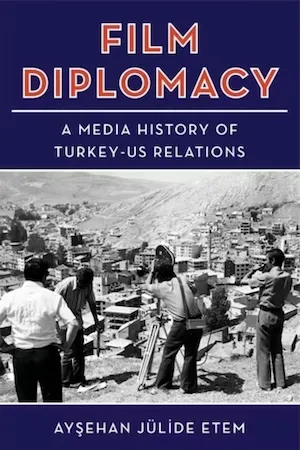
Film Diplomacy: A Media History of Turkey-US Relations
Etem, A. J. (2026). Film Diplomacy: A Media History of Turkey–US Relations. Columbia University Press.
Available here →June 21, 2026
20260621-aysehan-julide-etem-film-diplomacy
The wide angle
The rest of this thread

Ayşehan Jülide Etem
Ayşehan Jülide Etem is Assistant Professor of Media Studies at the University of Virginia, where she directs the Film Studies Concentration and chairs the Film Studies Curriculum Committee. Her research examines how film operates within institutional infrastructures to shape public opinion, manage populations, and mediate power. She is the author of Film Diplomacy: A Media History of Turkey–US Relations, forthcoming from Columbia University Press, and works across media, film, history, and diplomacy.
Pull this thread
pulls againstpulls alongside
Educational film built, circulated, measured and naturalized Turkish modernization rather than documenting it.
Against CF · Americans today are not more mobile, less religious or more consumerist than their ancestors, and what changed is security. On: Nostalgia is a delusion about a past that never existed
Against MD · Nostalgia is itself a form of speculative fiction, and that is what links fandom to reactionary politics. On: Nostalgia is a delusion about a past that never existed
Alongside RH · Humans are themselves a technology, and that technology is analog, so digital does not reflect what we are. On: Nostalgia is a delusion about a past that never existed
Alongside MS · Nostalgia is a category for critical reflection, and Shanghai's regional foodways are an objection to modernity. On: Nostalgia is a delusion about a past that never existed
Alongside ML · The European musical past survives in twentieth-century American media as a vernacular register ordinary listeners hear fluently. On: Nostalgia is a delusion about a past that never existed
Alongside LB · Americans' fond recollection of the recent modern past is a defensible appraisal of things actually lost. On: Nostalgia is a delusion about a past that never existed
Know something the rest of us don't?
Most threads on Rorotoko begin with our invitation. Any thread can begin with a proposal: you write it with the same prompts every thread answers, and we read it.
Propose a thread →