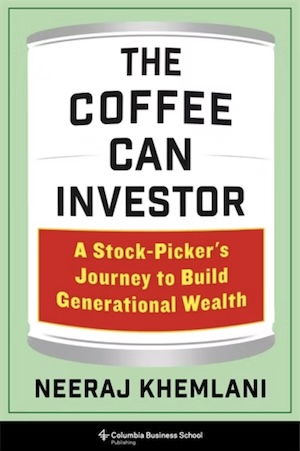
The Coffee Can Investor tells the story of Matt Ankrum, a midwestern stock picker who is building the ultimate lottery ticket for his three daughters—a coffee can full of stocks that he believes could be worth as much as half a billion dollars someday.
Matt is an advocate of investing in companies for the long term, not trading stocks. He has studied companies that have multiplied in value 100 times. They're called hundred baggers and the process usually takes 30 years. Matt uses the clues of what these 100-baggers have in common to identify new companies that he thinks can also endure well into the future. Along the way, he teaches his daughters about these companies and in the end, over a Thanksgiving break, surprises them with what he is doing for them.
The book is a cross between Rich Dad, Poor Dad and Jim Collins's Good to Great (which highlights his incredible research).
I grew up working for the late Peter Jennings at ABC News and Dan Rather at CBS News and produced pieces for 60 Minutes, some of the most important people and shows in television journalism. I've done all kinds of stories, and in addition to foreign affairs and investigative work, I've always been interested in business. Part of that is because the media business is always changing, and as a storyteller, you want to make sure when you do a story, you can get it to as many people as possible. So, understanding how the business is changing has always been something I have prioritized. I spent parts of my career at Yahoo! News and Finance, and at Hearst, where we would acquire companies. So as much as I'm a storyteller, I'm also an operator and an investor at the same time. These different experiences led me down the path of telling stories about great investors and businesses.
From another angle, my wife (who is also an author and social worker) and I have twins who are in college, who are learning how to make their own way. At a time where the average hold time of a stock is five and a half months and declining, and average retirements are between $300,000 and $400,000, I wanted my kids to learn the right way to invest for the long term. It's almost like taking a golf lesson in your fifties, after you've spent decades learning all the wrong things to do. I wanted to pass on to them at an early age what I've learned over a lifetime, so that they can start to build their own futures, and the futures of my grandchildren. That was an important piece for me.
There are a lot of things Matt has discovered that these kinds of companies have in common. Everything from growing revenue 20 percent year, over year, over year, and improving profit margins year, over year, over year, to being in industries that have giant total addressable markets and have the ability to grow their business by acquiring businesses along the way. The headline that struck me the most was that 68 percent of the 100-baggers he studied were B2B (business-to-business) companies, not B2C (business-to consumer) companies. Everyone knows B2C companies like Nike and the Apple. It's the other B2B companies that you rarely hear about. They're creating and offering products that are completely essential to other businesses that they need to function. One example of a company that grew one hundred times in value was Fastenal, which provides nuts and bolts to construction companies. A simple business that just compounded over time. That really resonated with me because at Hearst, I watched our CEO start to move capital allocation toward acquiring B2B media companies (data and information providers to other businesses) instead of just B2C companies like newspapers and magazines. So that insight really brought us close together on this project.
I'm fascinated by investors, by what they do, and I like getting in their heads about how they think about the future. This is a book where I was able to get close to someone who had unique proprietary research about what these 100-bagger companies had in common and was taking a big bet himself on the future. He and his wife were putting $5 Million of their own money into stocks he believed could multiply 100 times and placed them in a coffee can that he would hold for 30 years. He hopes it will turn into half a billion dollars. That's an intriguing narrative arc to me. And I'm in the process now of doing something similar with another investor who's making an even bigger bet, but instead of stocks, he in invests in real estate. The idea of "investing adventures" is a fascinating area I want to continue to explore, especially if you can get access to people with sound strategies.
Columbia University Press, and the business school press — which is home to value investing, home to Warren Buffett, home to Benjamin Graham (author of The Intelligent Investor) — is a great partner on this series. With their editorial, academic and peer reviews, I know I am getting plenty of smart feedback from a very prestigious publisher.
Ongoing thread. More from Neeraj Khemlani to follow.