
Gabriele Neri
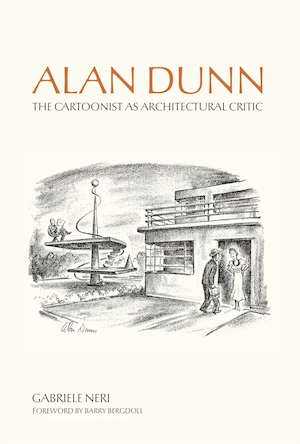
Alan Dunn: The Cartoonist as Architectural Critic
This has been a long-standing obsession of mine. For nearly twenty years — ever since I was a student — I have collected caricatures, cartoons, satirical and humorous illustrations about architecture from newspapers, magazines, periodicals, private archives belonging to architects and artists, civic collections, and antique shops. To these I have added films, animated cartoons, photomontages, and, more recently, memes and other digital content, all of which reveal unconventional ways of looking at architecture through humor, satire, parody, comedy, and related forms that often overlap and intertwine.
These images continue to surprise me. It is as though they reveal perspectives that the "serious," traditional debate on architecture is often reluctant to acknowledge. And I know those conventional approaches well: I have written numerous books and curated exhibitions on celebrated architects and engineers, on construction history, and on many other architectural subjects. Yet cartoons have the power to disorient and unsettle us in unexpected ways. After all, the social and cultural significance of caricature, satire, irony, and laughter — once relegated to the margins — has long been recognized by thinkers ranging from Charles Baudelaire and Henri Bergson to Mikhail Bakhtin, Umberto Eco, and many others.
Over the years, I have collected thousands of these images from across the world: Europe and the United States, Australia and Russia, Latin America and Asia. It has been an exciting and constantly surprising pursuit, one that continues to this day. My question has always remained the same: can we understand the gravity of architecture through the lightness of laughter?
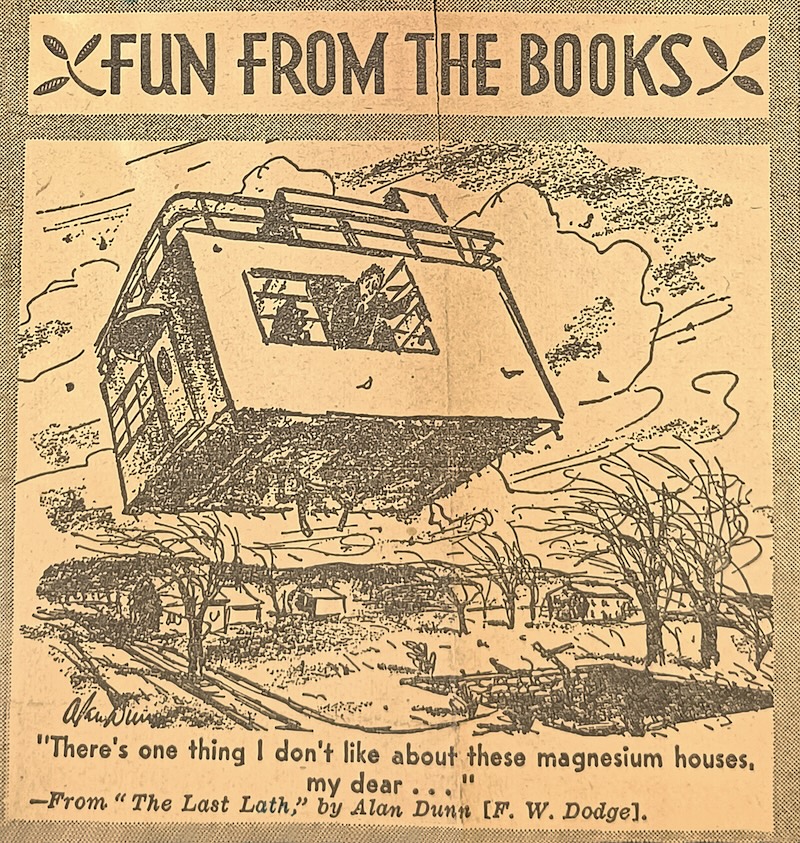
A few examples may help explain what I mean. In Barcelona, Antoni Gaudí's famous buildings were considered so strange that they became the subject of countless caricatures portraying them as codfish warehouses, airship garages, or zoos for exotic animals — a way of exorcising their unsettling novelty. In Germany, hundreds of cartoons targeted the Bauhaus, accused of producing houses that looked like little boxes — often leaking through their flat roofs — from which ornament had been banished. In the Soviet Union, the standardization of mass housing estates gave rise to an original form of satire despite censorship. In Australia, the construction of the Sydney Opera House — today the country's most iconic monument — was accompanied by an endless stream of cartoons mocking the building. Were these merely jokes? Far from it. Behind many of these seemingly playful images lay complex editorial, political, and economic agendas. Many anti-Bauhaus cartoons, for example, were actively supported by the Nazis.
Discovering Alan Dunn was a revelation for me. The opportunity to study his work in depth came through a fellowship at the Italian Academy for Advanced Studies at Columbia University in 2022, which allowed me to spend an extended period in New York. There, I worked extensively in several archives, especially the extraordinary collection at Syracuse University, where Dunn left behind letters, preparatory sketches, magnificent original drawings, endless lists of possible gags for future cartoons, photographs, writings, and much more. Piece by piece, I reconstructed not only his artistic career and his fascination with architecture and the city, but also his drawing methods, his sources of inspiration, his intellectual and social circles, his childhood, and even aspects of his personality. And, of course, his relationship with his wife, Mary Petty, herself a remarkable New Yorker artist.
Ongoing thread. More from Gabriele Neri to follow.
Curator: Bora Pajo
Alan Dunn: The Cartoonist as Architectural Critic
Neri, G. (2026). Alan Dunn: The cartoonist as architectural critic. The MIT Press.
Get the book →July 10, 2026
20260710-neri-alan-dunn-the-wide-angle
The wide angle
The rest of this thread

© Stefano Marras
Gabriele Neri
Gabriele Neri, Ph.D., is Associate Professor of Architectural History at Politecnico di Torino, Italy. He was a Weinberg Fellow at the Italian Academy for Advanced Studies in America at Columbia University in New York (2022) and has taught at the Accademia di architettura in Mendrisio, Switzerland, since 2012. He is currently a member of the Scientific Committee of Fondazione MAXXI, Rome. He contributes to several newspapers and magazines, including Il Sole 24 Ore and Architectural Record. He has curated various exhibitions and catalogues on twentieth-century architecture and design, including ARCHISATIRE. A Counter-History of Architecture (TAM, Mendrisio, CH, 2025–26).
Know something the rest of us don't?
Most threads on Rorotoko begin with our invitation. Some begin with a proposal. Both use the same prompts and the same editing, with your own pages in the archive. Proposed threads carry a small Sponsored label and a fee.
Propose a thread →