
Max Dosser
Nostalgic Futures: The Reactionary Fantasies of Speculative Fiction Fandoms
A central question Nostalgic Futures asks is: What is the relationship between the affective/emotional attachments that fans have to speculative fiction — things like science fiction and fantasy — and the logics of violence and exclusion that fuel broader reactionary movements? These can be neo-Nazis, white supremacists, men's rights activists, and so on. What links these seemingly very different things — fans loving spec fic, and the logic of violence and exclusion that fuels these reactionary groups? I contend that the answer is nostalgia and that nostalgia itself is a form of speculative fiction. It is when we imagine what things were like, even if they weren't really that way. That's where people get tripped up: this nostalgia for an imagined version of the past, a rose-colored-glasses version. Fans and reactionaries alike rely on imagined pasts to speculate how things should be in the present and the future.
I theorize something I call revanchist nostalgia, and that's the book's central theoretical claim. It's what the book really rests on. It builds on how Svetlana Boym describes restorative and reflective nostalgia. Restorative nostalgia is about people refusing to let go of the past — they want to rebuild it in the present. You can see it in things like national revivals and conspiracy theories, where people build an out-group to scapegoat for all their misfortunes: they are the reason we have lost our past, we need to get back to it.
Reflective nostalgia is more contemplative — you acknowledge that things have changed and are gone now, and you reflect on what that means for the present. Revanchist nostalgia is much more in line with restorative nostalgia, but it takes it a step further. Restorative nostalgia implies violence is involved in restoring the past; revanchist nostalgia makes that explicit. It aligns with the idea of revenge. It's not only retaking what we've lost — not only "making America great again," you could say — but punishing those who made us need this supposed reclamation in the first place. And typically, that means those are not white, not heterosexual, and not men.
A lot of sci-fi is about the future, but that's actually one reason I use the term "speculative fiction" in my book rather than science fiction. Speculative fiction is a broader supergenre that encompasses science fiction and fantasy, and some people would say horror or historical fiction too. But even when the work is about the future, it's often commenting on the present. Take Kim Stanley Robinson's Red Mars. He wrote it in 1992, and it's about people terraforming Mars somewhere in the 2020s. He's not trying to predict what's going to happen by 2026 — he's commenting on what's happening in the present by imagining what's going to happen in the future. He's saying, this is the ecological crisis we are currently in, and I'm going to comment on through creating this imagined world.
That's one thing speculative fiction is able to do really well, and historically it's been able to be published in times of great censorship because it seems to be about something completely different. You're writing about these alien worlds, these alien cultures — it's a seemingly pulp genre that only kids read. But in reality, these authors and other speculative fiction creators are using these other cultures, other worlds, other species, other time periods to comment on where we are now. So speculative fiction is inherently about the present, regardless of whether you're writing alternative pasts or imagined futures.
What I'm looking at is less what the media itself is saying and more how people get attached to it — how they begin to police it and say, this is the way it has to be. When The Lord of the Rings: The Rings of Power comes out, and there are Black elves and Black dwarfs, and people throw a fit — well, why do you care? What is it about your vision of this imagined world that has you so opposed to the presence of diversity? You can see it in fantasy, but you can also see it in Star Trek Discovery with Sonequa Martin-Green and Michelle Yeoh. When people saw the trailer, they freaked out because there was a Black woman and an Asian captain in it. Or when the new Star Wars came out and there was a Black Stormtrooper. These are imagined worlds, often set in the future, and yet people are taking their values from the present and projecting them onto these stories, rejecting what these imagined worlds are because they don't align with their present-day ideologies.
My book is called Nostalgic Futures: The Reactionary Fantasies of Speculative Fiction Fandoms, and I think the biggest misunderstanding in my work is that some people may see that and say, oh, you're saying that all of these fandoms are reactionary, that they're all aligning with this racist, misogynistic, homophobic ideology. That's not what I'm saying. Even when I talk about Star Wars: Episode VIII – The Last Jedi, and link anti-fandom and white supremacy in that chapter, I'm not saying that anyone who doesn't like the film is a white supremacist. It's a very natural thing to say: I'm attached to this media, I'm attached to this character, and the media has done something I don't like. Questioning canonical fidelity is fair. Oh, there's a Black Stormtrooper — how does that work? Previously, they were all clones of the same person, so does this make sense? But then you think about it more, and you go, well, maybe. It's been thirty-four years, two Death Stars exploded, maybe they got new recruits. Maybe you don't like that decision. But it's not racist for you to dislike that choice.
What I'm talking about is when it moves from "I don't like this" or "this doesn't fit with what I want" to something taking this into the public sphere and starting to attack the people responsible for creating the media. John Boyega, who plays Finn, the Black Stormtrooper, has talked about how he's gotten so many death threats and people saying they're never going to watch the movie because of him — just because he was Black. People moved from going "well, how does this work" to saying you don't belong here. That's the tension. It's perfectly fine to question, or even to say I don't personally like that. But when you move into attacking, into violence, into the exclusionary idea of, well, you can't be in this because they have to be all white — that's the area I'm talking about.
Ongoing thread. More from Max Dosser to follow.
Curator: Bora Pajo
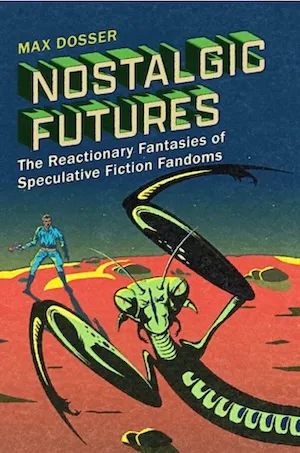
Nostalgic Futures: The Reactionary Fantasies of Speculative Fiction Fandoms
Dosser, M. (2026). Nostalgic Futures: The Reactionary Fantasies of Speculative Fiction Fandoms. Rutgers University Press.
Available here →July 19, 2026
20260719-dosser-nostalgic-futures-in-a-nutshell
In a nutshell
The rest of this thread

Max Dosser
Max Dosser is a senior lecturer in the Department of Communication Studies at Vanderbilt University. He is the co-founder and editor of Flash Point Science Fiction and the editor of Tipping Point: Ecofiction for Tomorrow's World. Max's research and creative interests involve speculative fiction media, fan cultures, and affect studies and take the form of science fiction drabbles, fantasy flash fiction, folklore-inspired novelettes, interdisciplinary academic articles, and his book, Nostalgic Futures: The Reactionary Fantasies of Speculative Fiction Fandoms.
Pull this thread
Nostalgia is itself a form of speculative fiction, imagining a past that never was.
Know something the rest of us don't?
Most threads on Rorotoko begin with our invitation. Any thread can begin with a proposal: you write it with the same prompts every thread answers, and we review it.
Propose a thread →