
Lily Kelting
Against Heritage
Heritage is a story we tell ourselves about the past. And even more specifically, it's about how the past becomes a product that can be bought, sold, or traded on in the present. So my book, Against Heritage: The Reinvention of Traditional Foods is about how culinary traditions themselves become commodities, rhetorics, or even trends. The book compares heritage food revivals around the world, the New Southern food movement in the U.S., the New Nordic Cuisine made famous by Noma, and the burgeoning movement to re-popularize traditional foods and ingredients in India.
The book is also fairly polemical. By contrasting "heritage," which is essentially biased, with "history," a fuller narrative about the past, we can see the way that these food revivals serve the cultural and political interests of the present. This is probably clearest in the example of hip "New Southern" food in the U.S. South—the way ingredients and techniques rooted in the history of slavery are talked about (or, more likely, not) versus the way that grandmothers are talking about (constantly and very nostalgically). It's not just about cultural appropriation. I want to take a stance and critique the way the global resurgence of traditional foods is also linked to other regressive ideas about returning to the past politically and culturally. Implicit in or maybe standing behind my argument is an ecological one: this widespread agrarian nostalgia, in which something like a slow-roasted carrot becomes a kind of fetish object, is also linked to the imperilled future of agriculture worldwide as a result of climate catastrophe.
The title of the book's introduction is "It's About Time" because what I am really getting at is the way that the past, present and future are all tied together in this particular culinary moment. "Who controls the past controls the future," as George Orwell wrote. But I am also gesturing toward something less rooted in the linear time of late capitalism. I end one chapter with the Ghanaian image of the Sankofa bird, which reaches back to the past to bring it forward. I am against heritage because I am looking for truer and fuller ways to go back.
Ongoing thread. More from Lily Kelting to follow.
Curator: Bora Pajo
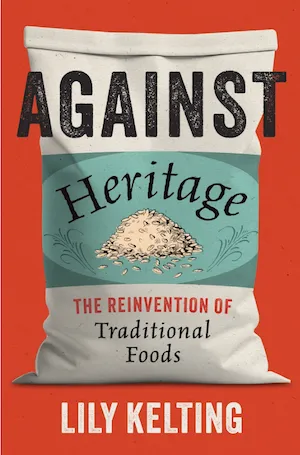
Against Heritage
Kelting, L. (2026). Against heritage: The reinvention of traditional foods. University of North Carolina Press.
Available here →July 28, 2026
20260728-lily-kelting-against-heritage-in-a-nutshell
In a nutshell
The rest of this thread

Lily Kelting
Lily Kelting has published about the terroir of trash for Emergence Magazine, sung the praises of the wildly inauthentic Indo-Chinese schezwan sauce for Vittles' Bad Food issue, and fumbled over the untranslatability of the word "yaar" (Off Assignment). She is the author of Against Heritage: The Reinvention of Traditional Foods (UNC Press/Sanctum Books 2026), which Dan Hicks called "urgently erudite, political, and beautifully written." She is an assistant professor of Literary and Cultural Studies at FLAME University.
Pull this thread
Heritage is not history but a biased story about the past turned into a product.
Know something the rest of us don't?
Most threads on Rorotoko begin with our invitation. Any thread can begin with a proposal: you write it with the same prompts every thread answers, and we review it.
Propose a thread →