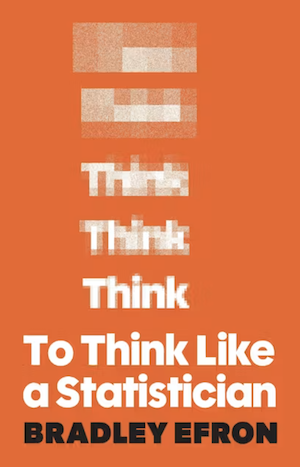
Is it a good idea to think like a statistician? A confident Yes here, admittedly by someone who earns his living doing so. We live in a random universe, where truth most often lies hidden beneath a fog of noise. Statistics is the science of peering through the fog and learning from experience, especially experience that arrives in sometimes contradictory pieces: Did the COVID vaccines save or cost lives? Is sugar good or bad for you? Are those paintings actually by Jean-Michel Basquiat?
This book is a tell-all of the tricks statisticians use to strip away the noise and see what's underneath (which is sometimes nothing at all). Definitely not a textbook, it's more of a guided cruise around the statistical seas, where dangers lurk for the unwary; no formulas, no theorems, no mind-numbing tables, but lots of examples from the media and my own statistical encounters (not all which were successful).
The detective shows I like to watch come in two varieties, the "arcs" that follow a single case all season, and "anthologies" where there's a new murder mystery each week. To Think Like a Statistician is more anthology than arc. Each chapter takes on a major statistical topic: correlation and causality; accuracy (Do the famous live longer than the rest of us?); prediction and the perverse law of waiting (the longer you wait, the longer you can expect to wait); comparisons (Is the new drug actually better than the old?); survival and risk; health news (Is anything good for you? Bad for you?); Bayes Rule and its dark side; and decisions and regrets (Should you open Monty Hall's third door?).
There is a little bit of "arc" in the book. Statisticians follow two competing philosophies, Bayesianism and frequentism, which lead to quite different methods of data analysis. Those differences show up in the algorithms that actually do the work described in my various chapters. This is one of those rare cases where philosophy directly affects practice, but a little philosophy goes a long way– advice I've tried to follow. Another arc traces the triumphs of a few famous statisticians, in particular the amazing Ronald Fisher, early 20th-century scientific polymath, who more than anyone else defined what it means to think like a statistician.
Ongoing thread. More from Bradley Efron to follow.