
Chirag Shah
Agent Nation: How Autonomous AI Is Rewriting the Rules of Society—and What We Can Do About It
Agent Nation is about a shift most people missed because they were busy arguing about something else.
For the past few years, the public conversation about AI has been a conversation about what AI says. Does the chatbot make things up? Will it write my emails? Is it coming for my job? Fair questions, all of them. They're also questions about a tool, and a tool doesn't do anything until someone picks it up.
The systems I write about don't wait to be picked up. They act. They screen your job application, price your insurance, route a patrol car, flag or clear a benefits claim, execute a trade, decide which patients get a follow-up call. They do it continuously, at a speed no human review process was ever designed to match, and usually without the person on the receiving end knowing a decision happened at all. That collection of actors is what I call Agent Nation. Not because they've organized into anything. Because together they now function as a layer of governance sitting between institutions and the people those institutions are supposed to serve.
Two misreadings come up a lot, so let me take them now.
The first is that this is another book about the coming AI apocalypse. It isn't. I'm not a doomer. I'm also not a booster. I'd call myself a pragmatist, which mostly means I think both camps skip past the unglamorous middle where the real harm and the real benefit actually live. Nobody writes a thriller about a permit approval system. That's exactly where I want the reader looking.
The second is about tense. People hear "autonomous agents" and file it under things to worry about later. There is no later. The hiring systems are deployed. The sentencing risk scores are in use. The claims systems have been running for years. We are already living inside the arrangement, which changes what kind of question this is. It stops being "should we allow this" and becomes "on what terms, and who gets to set them."
My central claim is that the problem isn't capability. It's accountability. When one of these systems harms someone, responsibility scatters. The vendor says it only built the software. The employer says it only bought it. The model says nothing, because it can't. Everyone in the chain has a defensible answer and the harmed person has none.
So the argument I make is for democratic oversight: the people subject to these decisions need real standing to contest them, not a feedback form. That's not a brake on the technology. It's the condition for trusting it.
Ongoing thread. More from Chirag Shah to follow.
Curator: Bora Pajo
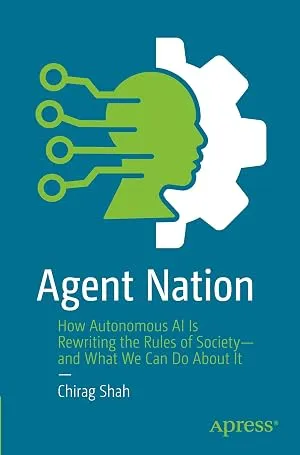
Agent Nation: How Autonomous AI Is Rewriting the Rules of Society—and What We Can Do About It
Shah, C. (2026). Agent nation: How autonomous AI is rewriting the rules of society—and what we can do about it. Apress.
Available here →September 9, 2026
20260909-shah-agent-nation-in-a-nutshell
In a nutshell
The rest of this thread

Chirag Shah
Chirag Shah is Professor at the University of Washington. He is Founding Director of the InfoSeeking Lab and Founding Co-Director of RAISE, the Center for Responsibility in AI Systems & Experiences. His research on search, recommendation, and AI accountability has appeared in nearly 200 peer-reviewed publications. He has held research positions at Amazon, Microsoft, and Spotify, and advises courts and federal agencies on AI. He is a Distinguished Member of ACM and ASIS&T.
Pull this thread
The problem with AI agents is accountability, not capability.
Know something the rest of us don't?
Most threads on Rorotoko begin with our invitation. Any thread can begin with a proposal: you write it with the same prompts every thread answers, and we review it.
Propose a thread →