
Noah Tsika
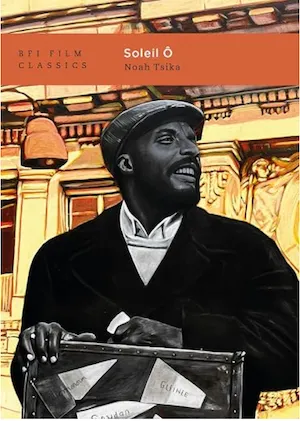
Soleil Ô
A fitting addition to the BFI Film Classics series, Soleil Ô (Oh, Sun), Med Hondo’s debut feature, remains as relevant today as when it was first shown to audiences in a fast-changing France in 1970. Building on such important African-cinematic precedents as Paulin Soumanou Vieyra’s Afrique sur Seine (Africa on the Seine, 1955) and Ousmane Sembene’s La noire de… (Black Girl, 1966) and Mandabi (1968), Hondo, who hailed from the Maghreb region of northwest Africa, chose to depict the thornier aspects of migration to France, where he lived from his early twenties until his death six decades later. He made the modern exilic experience his main subject, but he also managed to address the distant past, emphasizing some of Africa’s unheralded roles in world history. In some ways, Soleil Ô defies description. It is a documentary, an essay film, a work of autofiction, a combination of live action and animation. It is African. It is French. It is both. It is neither.
Because Soleil Ô was out of commercial circulation for decades, and scarcely even available to institutions of higher education, there isn’t all that much writing on the film. What relatively little there is—collected in a few anthologies on African cinema, none of them particularly recent—betrays several errors and inconsistencies. No one can seem to agree on how to date the film, or on its country (or countries) of origin. Some say that it was released as early as 1965 (when Hondo began serious preparations for the project), while others use 1967 and 1973 to denote its initial unveiling. I wanted to retrace the film’s production history partly to provide some much-needed clarification: begun in 1965, copyrighted (in script form) in 1967 (the year still cited by Google and some A.I. chatbots), Soleil Ô was not screened publicly until 1970, and most of the film was shot in 1969. It was made in France, from pre- to post-production, and not, as some claim, in Mauritania. That doesn’t mean that Soleil Ô shouldn’t be included in any corpus of African cinema. It means that its status is complicated, and I wanted to examine and articulate such complexities—and to show why they matter—in this book.
Ongoing thread. More from Noah Tsika to follow.
Curator: Bora Pajo
September 12, 2026
20260912-tsika-soleil-o-in-a-nutshell
In a nutshell
The rest of this thread

© Jason Vasha
Noah Tsika
Noah Tsika is Professor of Film and Media Studies at Queens College and the Graduate Center of the City University of New York. He is the author of 9 books, including African Media in an Age of Extraction: Nollywood Geographies and Traumatic Imprints: Cinema, Military Psychiatry, and the Aftermath of War. His current book project is a history of the idea of endless war and its relationship to cinema in the United States.
Pull this thread
Soleil Ô's complicated French origins do not disqualify it from African cinema.
Know something the rest of us don't?
Most threads on Rorotoko begin with our invitation. Any thread can begin with a proposal: you write it with the same prompts every thread answers, and we review it.
Propose a thread →