Darren Hudson Hick
The Love of Analog: Meditations on Value
This book doesn't really look like anything else I've published. Most of my work is argument-based; this one is exploratory and personal. Indeed, there is nary an argument to be found in it. This goes against all of my philosophic training. I simply wanted to identify and understand what it was that could explain my love of analog. Importantly, this was a project in learning what I value in my activities (bottom-up), rather than what there is to be valued in such activities (top-down). Pragmatism suggests that our values make up something of a web: rather than finding one value discretely tied to some given activity, we should expect to find our values spread throughout our lives, coming together in interesting combinations in our individual activities.
Ultimately, I identified three values that told me a lot about my love of analog—and, ultimately, about myself. Further research suggested that I wasn't alone in valuing these things. The first was the value of material. As many of us (myself included) spend most of our days at a keyboard and screen, our sensory experience of the world is reduced to a narrow channel. But our minds and bodies crave more, and analog goods offer rich, multimodal engagement. A vinyl record has heft. A used paperback has a smell. Board games offer all manner of sensory engagement, from shuffling cards to moving meeples around a track. That multisensory engagement is more than additive; it grounds us in reality.
The second value that I identified was the value of care. The notorious fragility isn't simply something working against analog; it engages us in a way that the digital doesn't. Readers of a certain age might remember 8-track tapes, a brief contender in the analog field. A notorious problem for 8-tracks was fixing them when the tape had gotten caught in the player and unspooled. Unlike cassette tapes, the problem couldn't be fixed with a handy pencil. Fixing an 8-track requires patience, a detailed eye, and (perhaps most importantly) the right attitude. That caring attitude won't just be about the 8-track copy of Meat Loaf's Bat Out of Hell that I managed to fix. Rather, that caring attitude is part of me, and caring for analog goods helps to promote that attitude in me.
Finally, I identified the value of agency—of feeling involved in my own activities. The digital world seems designed to take things out of my hands for the sake of ease and efficiency. When I stream an album on Spotify, I don't have to get up half-way through to flip it. My digital bookshelf automatically puts all my books alphabetically in their discrete categories. My video games don't have to have their parts separated into little plastic bags and put away in a box. But as a result, I am simply less richly involved in these things. And at least part of what I enjoy about analog is that I am involved—I can feel myself when I have to flip the record, organize my book collection, or set up a board game with a lot of fiddly little parts. There is a pleasure in doing that the analog embraces and the digital seeks so often to avoid.
Ongoing thread. More from Darren Hudson Hick to follow.
Curator: Bora Pajo
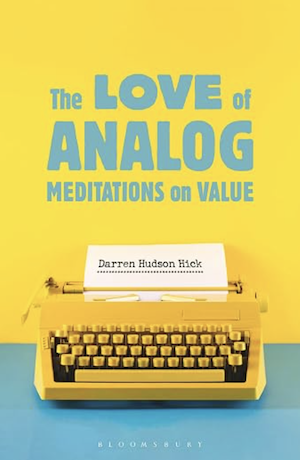
The Love of Analog: Meditations on Value
Hick, D. H. (2026). The love of analog: Meditations on value. Bloomsbury Academic.
Get the book →September 19, 2026
20260919-hick-the-love-of-analog-meditations-on-value-in-a-nutshell
In a nutshell
The rest of this thread

Darren Hudson Hick
Darren Hudson Hick is an Associate Professor of Philosophy at Furman University, where he teaches courses on things like the philosophy of horror, digital ethics, and the philosophy of copyright. He lives in Greenville, South Carolina, with his wife, Delaina, and their three cats. He prefers cha-chas to tangos, Scotch to bourbon, and kitsch to couture.
Know something the rest of us don't?
Most threads on Rorotoko begin with our invitation. Some begin with a proposal. Both use the same prompts and the same editing, with your own pages in the archive. Proposed threads carry a small Sponsored label and a fee.
Propose a thread →