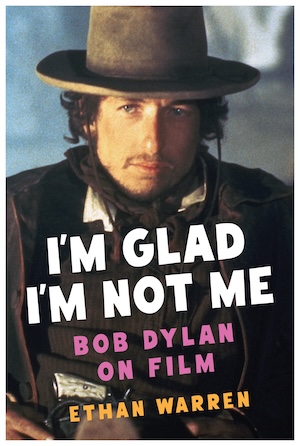
In this book, I argue that Bob Dylan has been consistently entwined with the history of American film going back more than half a century. While many of us are likely familiar with a handful of his credits as an actor, or a documentary subject, there's far less awareness of his work as a director himself (largely because his projects have not been officially released, even decades after their completion), as well as the more surprising corners of his acting career (how many of us remember his guest appearance on Dharma & Greg?), and that's to say nothing of the long list of music videos he's appeared in since the dawn of the form. Dylan has had surprising intersections with, and impacts on, the history of cinematic storytelling, from being the subject of an early experimental documentary, D.A. Pennebaker's Don't Look Back, to his remarkably effective stunt casting in Sam Peckinpah's revisionist Western Pat Garrett and Billy the Kid. While I do touch upon the biographical facts of Dylan's life, I'm far more interested in him as an icon, a link in the chain between figures as diverse as James Dean (an avowed obsession of the adolescent Dylan) and Andy Warhol (for whom Dylan appeared as part of a series of filmed celebrity portraits). A 1965 issue of Esquire featured Dylan on the cover as one of the four most influential figures among American youth, alongside Kennedy, Castro, and Malcolm X—to include any artist in that list was a remarkable gesture, let alone a popular musician, and I'm fascinated by the tremendous power of Dylan's image, most particularly how it changes the text and the context of any film in which he appears. Certainly the most renowned recent use of Dylan's visage onscreen was A Complete Unknown, the 2024 biopic starring Timothée Chalamet, and while I find the film frequently effective (particularly that startlingly good central performance), it also perpetuates a number of myths surrounding the moment that Dylan “went electric” at the 1965 Newport Folk Festival. Through multiple viewings, I've been consistently disheartened by that sequence, which not only mixes and matches famous elements from concert appearances that actually spanned years and continents, but also confuses the narrative by hewing to the accepted legend of mass hysterical rage in the audience, with only scattered concessions to the apparently true spectrum of reactions in the crowd. I bookend I'm Glad I'm Not Me with a useful counterexample: Murray Lerner's 1967 documentary Festival!, which surveyed several years of evolution in the famed Newport gathering, climaxing with Dylan's infamous electric performance. Where A Complete Unknown director James Mangold uses the tools of fictionalization to tell a story he clearly considers coherently satisfying, Lerner shows a more unvarnished side of the evening, and the results are (pardon the phrase) electrifying.
Ongoing thread. More from Ethan Warren to follow.