
Seven Rasmussen
Cloudy with a Chance of Starships: How the Drake Equation Reveals the Odds of Life in the Cosmos
The Drake Equation is a seven-variable expression that tells us how many civilizations we could talk to in the Milky Way right now. A lot of people have set out to answer the Drake Equation—I’m here to tell you why we can’t. More than anything, it’s an educational vehicle that I use to talk about all the incredible things that had to happen for life to evolve on Earth.
I’ve loved astrobiology since watching Carl Sagan’s Cosmos series online. One thing that spoke to me about Sagan’s work was how much he truly loved the science, the Earth, and the people on it. I don’t see much of that spirit these days. One thing that motivated my departure from traditional academia was that the world is kind of on fire these days! We are experiencing a lot of the environmental and policy outcomes Sagan warned us about in the ’80s and ’90s. It was hard for me to focus on other planets when ours is being destroyed by capitalism-driven climate change. So I set out to write an astrobiology book that was cognizant of the world and the moment we live in. It would be dishonest of me not to talk about it! Neutrality only serves the powerful few who are committing these crimes against the rest of us. Eat the rich!
I think this quote from the last chapter sums it all up quite nicely:
“All that we can be certain of is that life on our small planet is extraordinary, simultaneously fragile as a flower and more resilient than the great mountain ranges of bygone eras. Yet no matter how large our telescopes or powerful our rockets, the hand we extend out into the galaxy must be matched by one we use to save ourselves. Astrobiology is a science, but science is done by people, right here, right now, each one a tile of a shifting mosaic of the global stage. “Only by doing the best we can with the very best that an era offers,” said the man behind the equation, nearly two decades later, “do we find the way to do better in the future.”
Curator: Bora Pajo
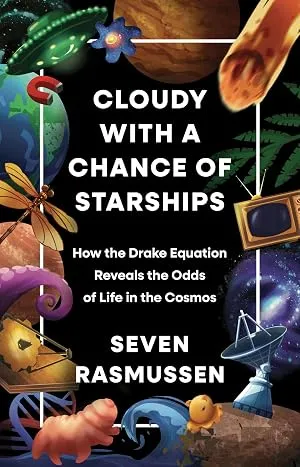
Cloudy with a Chance of Starships: How the Drake Equation Reveals the Odds of Life in the Cosmos
Rasmussen, S. (2026). Cloudy with a chance of starships: How the Drake equation reveals the odds of life in the cosmos. Princeton University Press.
Available here →October 11, 2026
20261011-rasmussen-cloudy-with-a-chance-of-starships
In a nutshell
The rest of this thread
.webp)
© Cade Twilley
Seven Rasmussen
Seven Rasmussen is an astrobiologist, author, and science communicator whose work has been featured widely in the media, including Popular Science, Wired, Nature, Scientific American, Inside Higher Ed, Science, and Space.com. She is currently an instructor at Columbia University and in the CUNY system. Rasmussen is a full member of Science Fiction and Fantasy Writers of America (SFWA) whose literary speculative fiction has appeared in Clarkesworld, Diabolical Plots, Neon Hemlock, and more. She can be found online as @toomanyspectra.
Know something the rest of us don't?
Most threads on Rorotoko begin with our invitation. Some begin with a proposal. Both use the same prompts and the same editing, with your own pages in the archive. Proposed threads carry a small Sponsored label and a fee.
Propose a thread →