
Nathan Wainstein
Bad Writing in the Modernist Novel
This book argues that academic literary criticism has a strange relationship to artistic failure. And this relationship can be summed up in two parts. On the one hand, professional literary critics are very resistant to making negative aesthetic judgments about sentences, or form, or narrative structure. It's common to find literary critics making positive judgments, saying that this is ultimately an interesting, a well-structured, an aesthetically generative instance of literary form. But there are very few examples of the contrary. This actually goes all the way back to antiquity: there's a long history of specialized interpreters who refuse to recognize artistic flaws in great works of literature.
The newer, and maybe more interesting, aspect is the second part, which is that not only are literary critics allergic to recognizing artistic failure, but they've actually been trained over the past several decades to fixate on, and highly valorize, moments that look like artistic failure. One constantly sees literary critics fetishizing instances where grammar is incorrect, or where syntax breaks down; where plots are incoherent or simply don't make sense; where characters are described doing something that they could never do; where realism more broadly breaks down into something like sci-fi or fantasy or another genre. One could say that this emphasis on what I call the negative moment, or negative form, in literature, and specifically the novel, is inspired by recent theoretical frameworks like deconstruction or trauma theory. Deconstruction would be the most notorious one, but there are others. Even psychoanalytic criticism is highly attuned to moments where a story doesn't make sense, because the psychoanalyst will say, ‘that's repression, that's where your truth actually lies’.
Bad Writing in the Modernist Novel argues that this goes all the way back to modernism, and that modernism is really the most interesting place to situate this drive. Literary modernism is an artistic movement that praises formal deviance more than any movement before it. So I suggest that modernism has trained literary theory to fetishize these moments of formal breakdown, while also thinking of them as experimental, or progressive, or aesthetically good, broadly speaking. I want to emphasize that it's a twofold drive on the part of critics. On the one hand, it's a fetishization of these moments. On the other hand, it's a reluctance or refusal to read them as artistic failure, even though a non-specialist reader, a non-academic reader, a book reviewer, or someone in a writing workshop would know very well that that moment of incoherence could just be a mistake. So this is also, in a way, about suppressing a kind of critical or readerly common sense, in a gesture that's become characteristic of how critics work.
Modern art is a good example. There are examples since the beginning of the Western art tradition, but it's really with modern art that it became programmatic, representative of an entire tradition of art, to intentionally break the rules. We need to recognize that even people who are intentionally breaking rules will also unintentionally break rules. So just because an artistic movement allows for and even promotes the breaking of rules doesn't mean that every breaking of a rule is de facto, or by default, good, or intentional.
This is why it's such an interesting question for me: it's precisely at that modernist moment where it becomes uniquely difficult to say whether a moment of rule breaking is intentional or not. By studying the modernist novel closely, and looking at instances of apparent bad writing or artistic failure in it, we can get more specific, more precise, about the nature of this modernist ambiguity between failure and artistic progress, and maybe find ways to move past it, or to view it with some skepticism.
People would say “we're in postmodernism, or we're in post-postmodernism”, but I think we are in many ways still locked in a modernist paradigm. Insofar as we're thinking through the status of rule-breaking in art, we're still very much modernist.
Ongoing thread. More from Nathan Wainstein to follow.
Curator: Bora Pajo
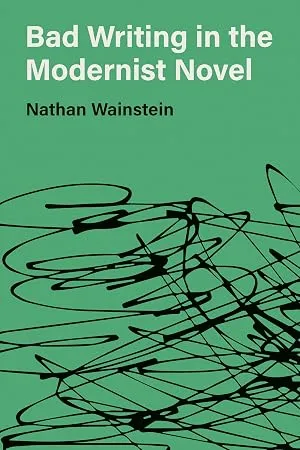
Bad Writing in the Modernist Novel
Wainstein, N. (2026). Bad writing in the modernist novel. Johns Hopkins University Press.
Available here →October 29, 2026
20261029-wainstein-bad-writing-in-the-modernist-novel-in-a-nutshell
In a nutshell
The rest of this thread

© Lisa Winner Photography
Nathan Wainstein
Nathan Wainstein is Assistant Professor of English at the University of Utah. He is the author of Bad Writing in the Modernist Novel (JHUP, 2026) and Grant Us Eyes: The Art of Paradox in Bloodborne (Tune and Fairweather, 2025). His work has appeared in Representations, Novel: A Forum on Fiction, Textual Practice, and LARB, among other venues. He hosts the podcast Authors Die Twice with Bryan Counter.
Pull this thread
Critics prize broken rules in modernist novels and refuse to admit that some are simply mistakes.
Know something the rest of us don't?
Most threads on Rorotoko begin with our invitation. Any thread can begin with a proposal: you write it with the same prompts every thread answers, and we review it.
Propose a thread →