
Rachel A. Shelden
The Political Supreme Court: A Forgotten History
At his 2005 confirmation hearing to become Chief Justice of the United States, then-nominee John Roberts famously told the U.S. Senate that “Judges are not politicians.” Roberts’ position—that the Supreme Court should be apolitical—has been repeated in some form by most of the sitting justices over the past two decades. According to public opinion polls, it’s also a position that appeals to most Americans. Even critics of the current Supreme Court tend to believe that the justices should operate outside of politics, whether or not the Court has strayed from that ideal today. But for the first 100 years of the nation, the idea of justices as politically neutral would have been baffling. The early Supreme Court was a political institution both by design and in practice.
The founding generation designed the Supreme Court to serve as a representative institution, in which justices were responsive and responsible to the people. Members of the Court were required to “ride circuit”—to serve concurrently as federal circuit judges in the states. Justices spent most of their year not in the capital, but riding from courtroom to courtroom in their assigned circuit, holding federal jury trials, interacting with average citizens and the local legal community. That community overlapped significantly with partisan political leadership of the region at both the state and federal level. As a result, while on circuit, justices forged important partisan political connections that, in many ways, would prove far more important than the legal decisions they made on the highest Court.
Both on circuit and in the capital, members of the Court engaged in partisan politics in myriad ways, large and small. Among many other activities, they advised state and local leaders as well as congressmen on legislation and even wrote that legislation in some cases. They similarly advised presidents and wrote executive addresses. Members of the Court penned newspaper articles on a variety of topics ranging from their own decisions to those of other judges, and from executive or legislative policy to partisan ideology. Justices frequently participated in presidential and congressional campaigns by endorsing friends, working behind the scenes to promote a favorite, and even hosting the equivalent of early fundraisers. Many were candidates for other offices from the bench—at the local, state, and federal level. In the first 100 years of the nation, roughly a third of sitting justices were presidential candidates.
This political activity was not corruption; Americans mostly accepted justices’ partisan behavior because the Court did not have the kind of intrinsic power to interpret the Constitution that we accept today. While many Americans believed that the justices could review a constitutional question in a single case, a majority insisted that the people retained the ultimate power to say what the Constitution meant. Without absolute constitutional authority, the justices’ politicking did not appear to be an existential threat to democracy.
Ongoing thread. More from Rachel A. Shelden to follow.
Curator: Bora Pajo
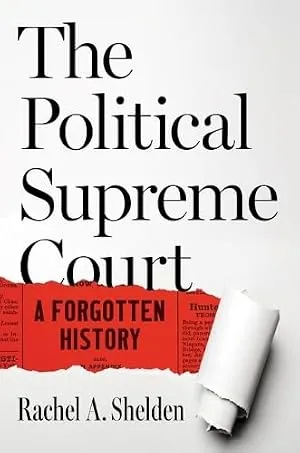
The Political Supreme Court: A Forgotten History
Shelden, R. A. (2026). The political Supreme Court: A forgotten history. University of North Carolina Press.
Available here →November 1, 2026
20261101-shelden-the-political-supreme-court-in-a-nutshell
In a nutshell
The rest of this thread

Rachel A. Shelden
Rachel A. Shelden is an associate professor of history and director of the Richards Civil War Era Center at Pennsylvania State University. Her scholarship and teaching focus on politics, constitutionalism, and law, particularly in the nineteenth century. She is the author of two books, The Political Supreme Court: A Forgotten History (2026) and Washington Brotherhood: Politics, Social Life, and the Coming of the Civil War (2013). In addition to writing for news outlets such as the Atlantic, the Washington Post, and the Philadelphia Inquirer, Shelden is a member of the Brennan Center’s Historians Council on the Constitution.
Pull this thread
For its first hundred years the Supreme Court was a political institution.
Know something the rest of us don't?
Most threads on Rorotoko begin with our invitation. Any thread can begin with a proposal: you write it with the same prompts every thread answers, and we review it.
Propose a thread →