
Eranda Jayawickreme
Is There Always Value to Adversity? Looking Beyond "What Doesn’t Kill You Makes You Stronger"
If bad things had good outcomes, you wouldn't call them bad things.
I'm making the case that we shouldn't trust research on post-traumatic growth because of the methodological concerns, and because in many ways the research flatters a particular narrative that we already buy into.
There's a reason why we say that what doesn't kill us makes us stronger. There's a reason why we buy into the idea that there are benefits to adversity. I think one reason is that thinking something bad has some positive benefit can help us gain a sense of agency over the event. If you feel like, ‘oh, this bad thing happened to us, but I'm going to find some good in it’, we are asserting control. Also, if you believe that a bad thing can lead to good outcomes, that by definition makes a bad thing less bad. If you can point to specific things that changed for the better, then the impact of the event wasn't uniformly bad. And thinking about people who have done well, or who have grown from adversity, can give you, if you are struggling, a sense of reassurance. A sense of ‘I'm not going to feel this bad forever. Other people have gone through this, and look at how they're doing. So there's some hope for me’.
On the other hand, one of the challenges with this idea is that it can put people under undue pressure. If something terrible has happened to you, and you feel like other people have done really well, or other people have grown, then not only do you have to recover from the event, you also have to somehow move past how you were before, and become strong, and grow. This idea that you can grow from adversity also assumes that if you can just try hard enough, if you can put in the work, you can overcome it. So it puts a lot of pressure on the individual to overcome trauma and adversity.
I think this has implications for how we do research on this question. There's a long-standing program of research, developed over the last 30 years or so, on post-traumatic growth. The idea that people can grow in terms of their life appreciation, their personal strength, their spirituality, their openness to new possibilities, the quality of their relationships. But a lot of the research is done using cross-sectional studies, where you just ask people, have you grown following the event? It's the way we would ask our friends, or maybe the way a therapist would talk to us. The problem is that in many cases, when we give responses to those questions, we're not really relying on information relevant to actual change. We are using cultural scripts, or we are saying we have grown because saying we have grown is a coping strategy. Believing in the silver lining can help you gain more control over the event, it can help you feel like the event isn't as bad, but it doesn't really reflect change or transformation.
If you look at the research that has tracked people over time, you get a much different picture. For the most part, you see evidence of resilience, which is not a bad thing. But for the most part, people don't shift in the wake of adversity. So I think one reason we're drawn to this research, even though, as I argue in the book, the quality of the research isn't very good, is that we already buy into the idea that it would be a good thing if we grew. We're less likely to critique research that gives us a finding we already like. We are humans doing science, and I think it's particularly hard when we're doing research on beliefs that seem true to us already, because as a result we give a pass to research that we should be critiquing more.
I also think about what it would mean to grow from adversity. I've done some work with the philosopher Michael Brady where we argued that if growth involves changes in your character, the way different philosophers and religious thinkers have spoken about it, then you have to define post-traumatic growth in terms of changes in your personality or your character. The Buddhist tradition is all about gaining wisdom and gaining compassion. From a philosophical perspective, it's about virtues like humility, or gratitude, or fortitude. And that's a high standard, because our personalities don't change that quickly. In the book, I talk about the different criteria that change needs to meet. There's some research suggesting that people who experience adversity do become more compassionate. I think there's a pretty strong evidence base for compassion being a trait, or a virtue, that can grow in the wake of adversity.
So the goal of the book isn't to say that post-traumatic growth never happens, or to debunk the idea. I don't want to take hope away from people. My argument is that we need to be clear-eyed about the culture that demands certain responses, not only because those responses, those narratives, can be unhelpful for people, but because it also impacts the quality of the research that we do.
Ongoing thread. More from Eranda Jayawickreme to follow.
Curator: Bora Pajo
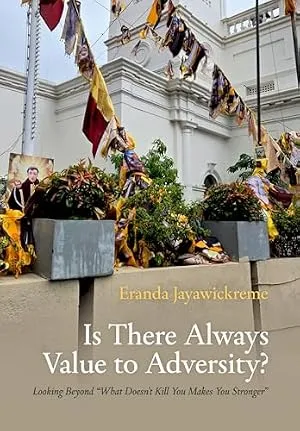
Is There Always Value to Adversity? Looking Beyond "What Doesn’t Kill You Makes You Stronger"
Jayawickreme, E. (2026). Is there always value to adversity? Looking beyond "What doesn’t kill you makes you stronger." Oxford University Press.
Available here →November 3, 2026
20261103-jayawickreme-is-there-always-value-to-adversity-in-a-nutshell
In a nutshell
The rest of this thread

Eranda Jayawickreme
Eranda Jayawickreme is Harold W. Tribble Professor of Psychology & Senior Research Fellow at the Program for Leadership and Character at Wake Forest University. His research focuses on the interdisciplinary study of moral and intellectual character, character formation in the wake of adversity, and flourishing. His awards include the 2023 Early Career Contributions Award from the International Society for the Science of Existential Psychology, the 2018 Faculty Excellence in Research Award from Wake Forest, and the 2015 Rising Star award from the Association for Psychological Science. He is currently editor-in-chief of Personality and Social Psychology Review.
Pull this thread
Research on post-traumatic growth is weak and survives because it flatters a story we already believe.
Know something the rest of us don't?
Most threads on Rorotoko begin with our invitation. Any thread can begin with a proposal: you write it with the same prompts every thread answers, and we review it.
Propose a thread →