
Trevor Bača
Stirrings Still
Memory doesn't retrieve the past: memory makes the present.
When does memory move from something a work of art represents to something from which the work of art is made? That question haunted me for the better part of 2016–18, during which I wrote the music for Stirrings Still, an hourlong work for speaking voice and string quartet built around Samuel Beckett's final work in prose. Finished in 1987 and first published the following year, Beckett's “Stirrings Still” traces the thought of one nearing the end of life. The words flicker between waiting and wondering, between recollection and anticipation, slowly outlining a sense of self that seems somehow to disappear before us as we read. Manfred Eicher, founder of ECM Records, had long cherished the text, recognizing in it an extraordinary musicality and imagining how that musicality might unfold as a recorded work for the label. Conversations between Eicher and the British critic, novelist and librettist Paul Griffiths led Eicher to ask Griffiths to find a composer who could create music alongside Beckett’s words, with Griffiths reading the text on the resulting ECM recording.
When Griffiths introduced me to the text in 2016, I was struck by the astringent beauty of the words, and even more by the truly strange way Beckett's writing activates the reader's own memory during the act of reading. Words and images recur; sentences double back on themselves; something that seemed incidental returns later carrying unexpected weight. Small words such as ‘again’ and ‘then’ continually force us to reconsider where, exactly, we are in time. These were my first intimations that the music I would write alongside the words might work with memory as a primary material of composition.
Throughout Stirrings Still, musical events return from elsewhere in the piece. Something heard much earlier suddenly enters the present. Elsewhere, something belonging to the future appears before we know what it is. A recollection opens inside another recollection, and then closes again. My hope was that, whether following music or words, listeners would not only recognize ideas as they return but feel those returns changing the present itself.
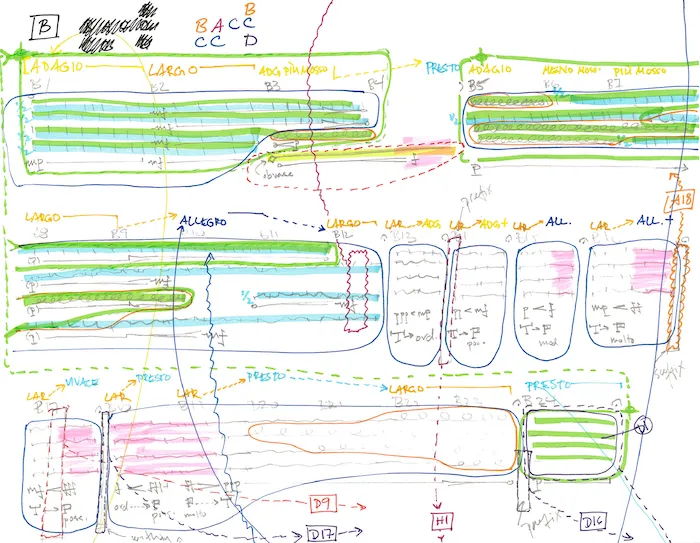
This matters because I think ordinary experience works this way, too. The present is real but it is rarely dimensionless. Our sense of now is enlarged, compressed, darkened or illuminated by the past it carries and by the future it anticipates. What happened yesterday changes the possibilities we feel in the present; what we hope for tomorrow changes the boundaries of today. Often these effects happen without us noticing, and we feel the weight of past or future times before we name them.
I came to think of memory in Stirrings Still in this sense, not as a source from which old things are retrieved but as an active force that changes the size and meaning of what is happening now. Beckett’s words and the quartet do this independently. The words remember something the music has left behind; the music reopens a past from which the words have moved away. At other moments both streams arrive at the same moment of return, but by different routes.
The result taught me something I didn't know before composing the music: memory doesn't take us out of the present into the past; memory is one of the things from which the present is continuously re-made.
Ongoing thread. More from Trevor Bača to follow.
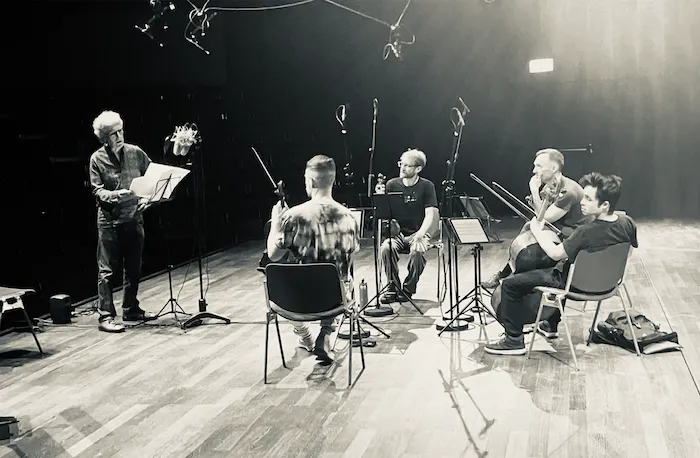
© Rourke O'Brien. In the photo: Paul Griffiths (reading the text), Christopher Otto and Austin Wulliman (violins), John Pickford Richards (viola), Jay Campbell (cello).
Curator: Bora Pajo
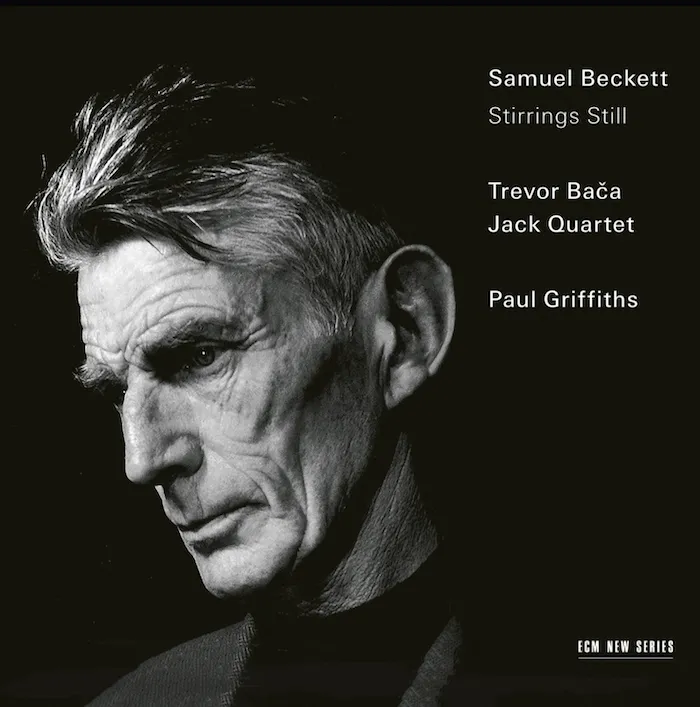
Stirrings Still
Available here →November 7, 2026
20261107-baca-stirrings-still-in-a-nutshell
In a nutshell
The rest of this thread
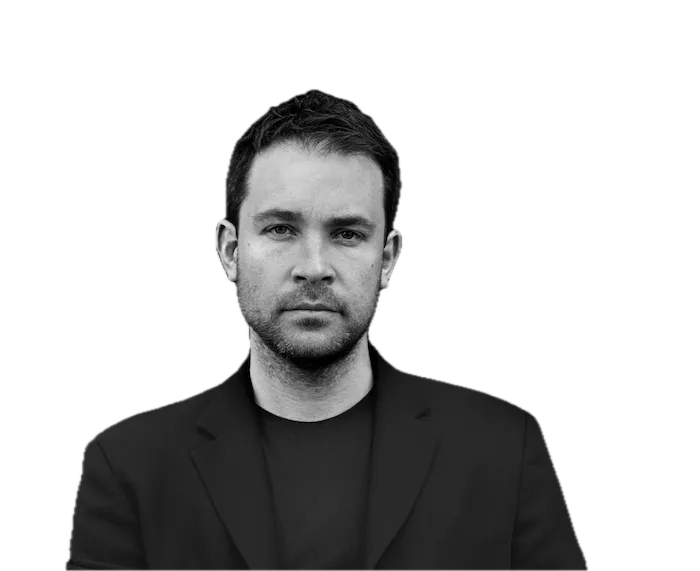
© Anneliese Varaldiev
Trevor Bača
American composer Trevor Bača (*1975) grew up in Texas. His concerns as a composer include lost and secret texts; broken and dismembered systems; sorcery, divination and magic; and the effects, action and beauty of light. Bača’s music has been played throughout the world with recent performances in Barcelona, Berlin, Boston, Cincinnati, Cologne, Curitiba, Darmstadt, Helsinki, Huddersfield, Leuven, Ljubljana, Los Angeles, Lyon, Maastricht, New York, San Diego, San Francisco, Thessaloniki, Tokyo, Trieste, Würzburg and elsewhere.
Bača’s music has been played by soloists and ensembles around the world. Ensembles include the Argento Ensemble (New York); Callithumpian Consort (Boston); the Debussy Trio (Los Angeles); Distractfold (Manchester); Either/Or (New York); Ensemble Dal Niente (Chicago); Ensemble Echoi (San Diego); Ensemble Mosaik (Berlin); ensemble recherche (Freiburg); Ensemble SurPlus (Freiburg); manufaktur für aktuelle musik (Cologne); Talea Ensemble (New York); and others. Soloists include Brian Archinal (Bern); Séverine Ballon (Paris); Nico Couck (Antwerp); Madison Greenstone (San Diego); Richard Haynes (Bern); Jonathan Hepfer (Los Angeles); Marc Horne (Barcelona); Carin Levine (Bremen); Reiko Manabe (Tokyo); Mark Menzies (Los Angeles); Corrado Rojac (Trieste); Jürgen Ruck (Würzburg); Jessi Rosinski (Boston); Alan Toda-Ambaras (Boston); Alice Teyssier (New York); Elizabeth Weisser (New York); and others.
Recent publications include “Abjad: an open-source system for formalized score control,” published in the proceedings of First International Conference on Technologies for Music Notation and Representation, at IRCAM / Sorbonne in Paris; “Nature, song, transfiguration,” a critical introduction to the instrumental music of Chaya Czernowin, published by Schott Music, in Mainz; “Music composition and the technologies of working together,” an assessment of open-source technologies for collaborative composition, in the journal Ideas Sónicas, in Mexico City; “Breath, blood, network of nerves: an accidental body poetics,” that theorizes the in-motion body and its parts; and “Unremitting ambiguity,” an analysis of The Flypaper, by composer Steven Kazuo Takasugi, published in the journal Search and reprinted in The Second Century of New Music.
Bača is the inventor of Abjad, a Python-based open-source software system for music composition. Since 2016 Bača has led weeklong intensive summer courses about Abjad at Stanford University’s CCRMA; Bača is proud to participate in Stanford’s Women in Computer Music Scholarship. In August 2009 Bača completed a two-week residency at Schloss Solitude in Stuttgart with performances by Ensemble SurPlus. Bača’s music has been anthologized as part of Notations 21 (edited by Theresa Sauer) and Bača’s scores have been exhibited as art at the Chelsea Gallery in New York City and at the Hutchins Gallery on Long Island.
Bača holds a PhD in music composition from Harvard University.
Pull this thread
Memory is a force that remakes the present, not a store from which the past is retrieved.
Know something the rest of us don't?
Most threads on Rorotoko begin with our invitation. Any thread can begin with a proposal: you write it with the same prompts every thread answers, and we review it.
Propose a thread →