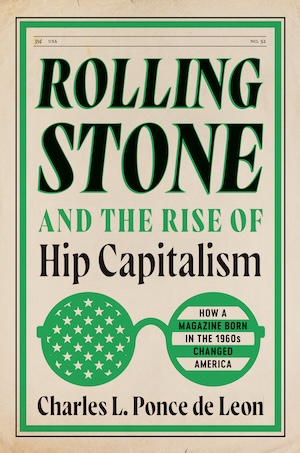
Ponce de Leon, Charles L. Rolling Stone and the Rise of Hip Capitalism: How a Magazine Born in the 1960s Changed America The University of North Carolina Press, 304 pages, 6 x 9 inches, ISBN 9781469694399
In a nutshell
This book is about a seemingly crazy idea that turned into one of the most remarkable publishing successes of the twentieth century. In 1967, Jann Wenner, a 20-year-old Berkeley dropout, and Ralph J. Gleason, a 50-year-old music journalist who had become his mentor, conceived Rolling Stone, a magazine inspired by a belief that rock music’s popularity with young people was a sign of an impending social and cultural renaissance that would transform America.
Wenner, its founding editor and longtime publisher, was committed to publishing more than just news about music. He fervently believed that the values and attitudes associated with rock were visible in other forms of contemporary culture and would reshape social norms and conventional politics. This commitment inspired Rolling Stone’s interest in film, literature, the visual arts, and new social trends. And by 1970, when it seemed as if this renaissance was imperiled by reactionary forces epitomized by the Nixon administration, it led Wenner to expand Rolling Stone’s coverage of politics and turn the magazine into a pioneering platform for left-liberal advocacy and an irreverent version of what Tom Wolfe called the “New Journalism.”
This expansion of the magazine’s mission boosted its reputation in the industry and made it an enormous commercial success. Wenner soon became a celebrity and the era’s quintessential “hip capitalist,” a young businessman who recognized how the tumult of the 1960s had changed the values and tastes of so many young people and made them yearn for products and experiences that were different, exciting, and “relevant.”
During the Seventies, changes in Rolling Stone’s audience, the magazine industry, the fields that Rolling Stone covered, and America itself compelled Wenner to alter the magazine in numerous ways. By the end of that decade, it was firmly ensconced within the journalistic mainstream, even while retaining some of the distinctive features from its early years. By the mid-Eighties, however, even these features were in short supply, as Rolling Stone adapted to the new commercial imperatives of a magazine industry increasingly committed to glitz and sensationalism.
The book focuses on Wenner and his staff’s efforts to interest and engage readers from the magazine’s founding to its twentieth anniversary in 1987. It pays close attention to its mix of features, sensibility, and editorial voice, and traces their evolution over time, as Rolling Stone sought to remain popular and relevant as the Seventies gave way to the Eighties. And it examines the magazine’s coverage of important social and political developments, and the contributions of its many distinguished writers, a cast that includes Greil Marcus, Hunter S. Thompson, William Grieder, and P.J. O’Rourke.
My aim in writing this book was to make readers aware that, in its early years, Rolling Stone was a serious magazine. And well into the Eighties, it continued to publish substantive feature articles that challenged readers and won plaudits from industry insiders. As a historian, I also want readers to recognize that Rolling Stone was a product of its times, and that the changes it underwent were pragmatic adaptations rather than “selling out,” a common charge levied against Wenner.
The wide angle
When I decided to write about Rolling Stone and read previous works about the magazine, I realized that I needed a new angle. It seemed like a good idea to try to produce a narratively focused cultural history. It’s a book that tells a “story,” with identifiable protagonists who confront challenges over a period of time. But I convey that story in a way that enables readers to see how Rolling Stone fit into the magazine industry and especially American culture during its formative years, and how its coverage of music, the arts, social trends, and politics allowed its writers to participate in wider discussions and debates.
I’ve been interested in the culture and politics of the 1960s for much of my professional career. Writing about Rolling Stone was an ideal way to dive into the subject and assess its legacy. It was also, in some respects, akin to coming home. Reading Rolling Stone as a college student in the late 1970s and early 1980s was as important a part of my education as any classes I took. It shaped my tastes and sparked intellectual interests—first about music, then about American culture and society more generally—that eventually led me to graduate school and a career as a professional historian. I think it’s no coincidence that much of my research and writing have focused on journalism and the mass media.
From these projects I’ve learned a lot about how professional journalism and the culture industries work, insights that I also incorporated into my teaching. My course on modern American cultural history, for example, examines the ways in which artists and intellectuals figured out how to make a living and express themselves while working with commercial publishing houses, newspapers and magazines, record companies, movie studios, and television networks. This emphasis makes students aware of the pressures and constraints that commercial institutions placed on “creatives.” But it also allows them to recognize and better appreciate instances when artists enjoyed a measure of freedom, with results that were sometimes pathbreaking.
Rolling Stone was textbook example of this. Wenner offered his writers a highly visible platform for their work, and often unprecedented freedom, resulting in some remarkably innovative and compelling journalism. But Rolling Stone was also a business, and business realities could also limit creative freedom and spark conflict between editors and writers, as well as between editors and the “business office,” the staff responsible for soliciting advertisers and attracting new readers, for ensuring Rolling Stone’s continued commercial success.
Some of the most vexing conflicts involved questions of taste, for example, whether to write about popular musicians or movies that the editorial staff and a portion of the readership strongly disliked. Writing about them made sense commercially and could draw new readers. But it could also anger established readers who valued the magazine precisely because of its discernment and support for lesser known, artistically significant artists and works. Ironically, if Rolling Stone wrote to please the largest crowd, it could lose its cachet and cease to be “hip.” And so, for many years, it resisted becoming thoroughly commercial—until the magazine industry and the culture had changed to such a degree that resistance no longer seemed to be an option.
A close-up
I hope they would start with the prologue, where I talk about my first experiences as a Rolling Stone reader back in the 1970s and how it contributed to my intellectual awakening and influenced my subsequent career.
It foregrounds one of the book’s main points—that Rolling Stone was far more than a music or pop culture magazine. It made me aware of things I had never known, and it encouraged me to make connections between my interest in music and subjects I was learning about in college.
This is particularly important for younger readers to realize. They may only be familiar with recent iterations of the magazine, which bear almost no resemblance to the Rolling Stone that existed in previous decades. But it’s good for older readers to remember, too.
Lastly
As a historian, one of my primary professional goals is to help people better understand the past. The recent past especially can seem familiar and encourage the mistaken belief that people and conditions in, say, the 1960s or the 1970s were essentially the same as they are today. In fact, they weren’t, and I hope readers of my book will recognize this.
Wenner and the editors and writers who worked for Rolling Stone in its early years were products of a particular time and place. Their aspirations for the magazine and the culture were shaped by this context and the opportunities and expectations it encouraged. They were ambitious, even utopian, because the occasion seemed to call for it. And the magazine reflected that, even while succeeding commercially.
The changes that the magazine underwent over the next two decades can also be explained by changes in the larger context, and an important aim of my book is to make readers aware of this, to encourage them to see things from the perspective of Wenner and his staff. From this vantage point, we can begin the appreciate the challenges they faced as their audience, the magazine industry, and American culture and society changed in ways that made Rolling Stone’s emphasis and identity seem poorly suited for the times. What succeeded commercially in the early 1970s wasn’t going to work by the late 1970s, and even less so in the 1980s.
Yet one of the most interesting discoveries that I made in researching and writing this book was the degree to which Wenner and Rolling Stone continued to promote many of the values and commitments forged during the magazine’s early years, despite changing times and clear evidence that many younger readers were more conservative. Though these features of the magazine were far less prominent than before, they were still visible well into the so-called “age of Reagan.” And I think the magazine’s continued dedication to them, even if inconsistent and watered down, suggests the ways in which some Sixties values worked themselves into mainstream American culture, influencing subsequent generations and bolstering public support for social liberalism.