
Charles L. Ponce de Leon
Rolling Stone and the Rise of Hip Capitalism
This book is about a seemingly crazy idea that turned into one of the most remarkable publishing successes of the twentieth century. In 1967, Jann Wenner, a 20-year-old Berkeley dropout, and Ralph J. Gleason, a 50-year-old music journalist who had become his mentor, conceived Rolling Stone, a magazine inspired by a belief that rock music’s popularity with young people was a sign of an impending social and cultural renaissance that would transform America.
Wenner, its founding editor and longtime publisher, was committed to publishing more than just news about music. He fervently believed that the values and attitudes associated with rock were visible in other forms of contemporary culture and would reshape social norms and conventional politics. This commitment inspired Rolling Stone’s interest in film, literature, the visual arts, and new social trends. And by 1970, when it seemed as if this renaissance was imperiled by reactionary forces epitomized by the Nixon administration, it led Wenner to expand Rolling Stone’s coverage of politics and turn the magazine into a pioneering platform for left-liberal advocacy and an irreverent version of what Tom Wolfe called the “New Journalism.”
This expansion of the magazine’s mission boosted its reputation in the industry and made it an enormous commercial success. Wenner soon became a celebrity and the era’s quintessential “hip capitalist,” a young businessman who recognized how the tumult of the 1960s had changed the values and tastes of so many young people and made them yearn for products and experiences that were different, exciting, and “relevant.”
During the Seventies, changes in Rolling Stone’s audience, the magazine industry, the fields that Rolling Stone covered, and America itself compelled Wenner to alter the magazine in numerous ways. By the end of that decade, it was firmly ensconced within the journalistic mainstream, even while retaining some of the distinctive features from its early years. By the mid-Eighties, however, even these features were in short supply, as Rolling Stone adapted to the new commercial imperatives of a magazine industry increasingly committed to glitz and sensationalism.
The book focuses on Wenner and his staff’s efforts to interest and engage readers from the magazine’s founding to its twentieth anniversary in 1987. It pays close attention to its mix of features, sensibility, and editorial voice, and traces their evolution over time, as Rolling Stone sought to remain popular and relevant as the Seventies gave way to the Eighties. And it examines the magazine’s coverage of important social and political developments, and the contributions of its many distinguished writers, a cast that includes Greil Marcus, Hunter S. Thompson, William Grieder, and P.J. O’Rourke.
My aim in writing this book was to make readers aware that, in its early years, Rolling Stone was a serious magazine. And well into the Eighties, it continued to publish substantive feature articles that challenged readers and won plaudits from industry insiders. As a historian, I also want readers to recognize that Rolling Stone was a product of its times, and that the changes it underwent were pragmatic adaptations rather than “selling out,” a common charge levied against Wenner.
Curator: Rachel Althof
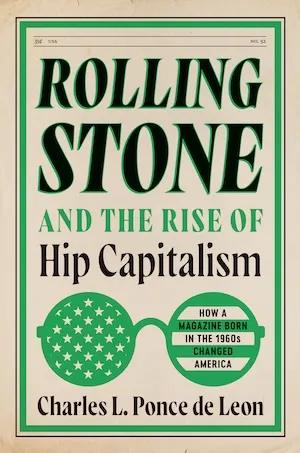
Rolling Stone and the Rise of Hip Capitalism
Charles L. Ponce de Leon (2025). Rolling Stone and the Rise of Hip Capitalism: How a Magazine Born in the 1960s Changed America The University of North Carolina Press, 304 pages, 6 x 9 inches, ISBN 9781469694399
Available here →January 11, 2026
20260111-poncedeleon-charles-rolling-stone
In a nutshell
The rest of this thread

Charles L. Ponce de Leon
Charles L. Ponce de Leon was born and raised in Palo Alto, California, and received his BA from UC Santa Barbara, where he was a college journalist and worked in community radio. He received his Ph.D. in United States History from Rutgers University, and has taught at Princeton University, Purchase College, and California State University, Long Beach, where is Professor of History and American Studies.
He is a specialist in U.S. cultural and intellectual history. His fields of expertise include mass media and the commercial culture industries, American intellectual life, and modern U.S. political culture. He has written three previous books: Self-Exposure: Human-Interest Journalism and the Emergence of Celebrity in America, 1890-1940 (University of North Carolina Press, 2001); Fortunate Son: The Life of Elvis Presley (Hill and Wang, 2006); and That’s the Way It Is: A History of Television News in America (University of Chicago Press, 2015).
Pull this thread
Rolling Stone's changes between 1967 and 1987 were pragmatic adaptations to a changing audience and country, not selling out.
Know something the rest of us don't?
Most threads on Rorotoko begin with our invitation. Any thread can begin with a proposal: you write it with the same prompts every thread answers, and we review it.
Propose a thread →