
Charles L. Ponce de Leon
Rolling Stone and the Rise of Hip Capitalism
I hope they would start with the prologue, where I talk about my first experiences as a Rolling Stone reader back in the 1970s and how it contributed to my intellectual awakening and influenced my subsequent career.
It foregrounds one of the book’s main points—that Rolling Stone was far more than a music or pop culture magazine. It made me aware of things I had never known, and it encouraged me to make connections between my interest in music and subjects I was learning about in college.
This is particularly important for younger readers to realize. They may only be familiar with recent iterations of the magazine, which bear almost no resemblance to the Rolling Stone that existed in previous decades. But it’s good for older readers to remember, too.
As a historian, one of my primary professional goals is to help people better understand the past. The recent past especially can seem familiar and encourage the mistaken belief that people and conditions in, say, the 1960s or the 1970s were essentially the same as they are today. In fact, they weren’t, and I hope readers of my book will recognize this.
Wenner and the editors and writers who worked for Rolling Stone in its early years were products of a particular time and place. Their aspirations for the magazine and the culture were shaped by this context and the opportunities and expectations it encouraged. They were ambitious, even utopian, because the occasion seemed to call for it. And the magazine reflected that, even while succeeding commercially.
The changes that the magazine underwent over the next two decades can also be explained by changes in the larger context, and an important aim of my book is to make readers aware of this, to encourage them to see things from the perspective of Wenner and his staff. From this vantage point, we can begin the appreciate the challenges they faced as their audience, the magazine industry, and American culture and society changed in ways that made Rolling Stone’s emphasis and identity seem poorly suited for the times. What succeeded commercially in the early 1970s wasn’t going to work by the late 1970s, and even less so in the 1980s.
Yet one of the most interesting discoveries that I made in researching and writing this book was the degree to which Wenner and Rolling Stone continued to promote many of the values and commitments forged during the magazine’s early years, despite changing times and clear evidence that many younger readers were more conservative. Though these features of the magazine were far less prominent than before, they were still visible well into the so-called “age of Reagan.” And I think the magazine’s continued dedication to them, even if inconsistent and watered down, suggests the ways in which some Sixties values worked themselves into mainstream American culture, influencing subsequent generations and bolstering public support for social liberalism.
Curator: Rachel Althof
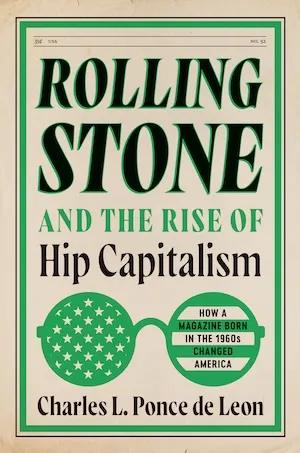
Rolling Stone and the Rise of Hip Capitalism
Charles L. Ponce de Leon (2025). Rolling Stone and the Rise of Hip Capitalism: How a Magazine Born in the 1960s Changed America The University of North Carolina Press, 304 pages, 6 x 9 inches, ISBN 9781469694399
Available here →January 11, 2026
20260302-poncedeleon-charles-rolling-stone
A close-up
The rest of this thread

Charles L. Ponce de Leon
Charles L. Ponce de Leon was born and raised in Palo Alto, California, and received his BA from UC Santa Barbara, where he was a college journalist and worked in community radio. He received his Ph.D. in United States History from Rutgers University, and has taught at Princeton University, Purchase College, and California State University, Long Beach, where is Professor of History and American Studies.
He is a specialist in U.S. cultural and intellectual history. His fields of expertise include mass media and the commercial culture industries, American intellectual life, and modern U.S. political culture. He has written three previous books: Self-Exposure: Human-Interest Journalism and the Emergence of Celebrity in America, 1890-1940 (University of North Carolina Press, 2001); Fortunate Son: The Life of Elvis Presley (Hill and Wang, 2006); and That’s the Way It Is: A History of Television News in America (University of Chicago Press, 2015).
Pull this thread
Rolling Stone's changes between 1967 and 1987 were pragmatic adaptations to a changing audience and country, not selling out.
Know something the rest of us don't?
Most threads on Rorotoko begin with our invitation. Any thread can begin with a proposal: you write it with the same prompts every thread answers, and we review it.
Propose a thread →