
Charles L. Ponce de Leon
Rolling Stone and the Rise of Hip Capitalism
When I decided to write about Rolling Stone and read previous works about the magazine, I realized that I needed a new angle. It seemed like a good idea to try to produce a narratively focused cultural history. It’s a book that tells a “story,” with identifiable protagonists who confront challenges over a period of time. But I convey that story in a way that enables readers to see how Rolling Stone fit into the magazine industry and especially American culture during its formative years, and how its coverage of music, the arts, social trends, and politics allowed its writers to participate in wider discussions and debates.
I’ve been interested in the culture and politics of the 1960s for much of my professional career. Writing about Rolling Stone was an ideal way to dive into the subject and assess its legacy. It was also, in some respects, akin to coming home. Reading Rolling Stone as a college student in the late 1970s and early 1980s was as important a part of my education as any classes I took. It shaped my tastes and sparked intellectual interests—first about music, then about American culture and society more generally—that eventually led me to graduate school and a career as a professional historian. I think it’s no coincidence that much of my research and writing have focused on journalism and the mass media.
From these projects I’ve learned a lot about how professional journalism and the culture industries work, insights that I also incorporated into my teaching. My course on modern American cultural history, for example, examines the ways in which artists and intellectuals figured out how to make a living and express themselves while working with commercial publishing houses, newspapers and magazines, record companies, movie studios, and television networks. This emphasis makes students aware of the pressures and constraints that commercial institutions placed on “creatives.” But it also allows them to recognize and better appreciate instances when artists enjoyed a measure of freedom, with results that were sometimes pathbreaking.
Rolling Stone was textbook example of this. Wenner offered his writers a highly visible platform for their work, and often unprecedented freedom, resulting in some remarkably innovative and compelling journalism. But Rolling Stone was also a business, and business realities could also limit creative freedom and spark conflict between editors and writers, as well as between editors and the “business office,” the staff responsible for soliciting advertisers and attracting new readers, for ensuring Rolling Stone’s continued commercial success.
Some of the most vexing conflicts involved questions of taste, for example, whether to write about popular musicians or movies that the editorial staff and a portion of the readership strongly disliked. Writing about them made sense commercially and could draw new readers. But it could also anger established readers who valued the magazine precisely because of its discernment and support for lesser known, artistically significant artists and works. Ironically, if Rolling Stone wrote to please the largest crowd, it could lose its cachet and cease to be “hip.” And so, for many years, it resisted becoming thoroughly commercial—until the magazine industry and the culture had changed to such a degree that resistance no longer seemed to be an option.
Curator: Rachel Althof
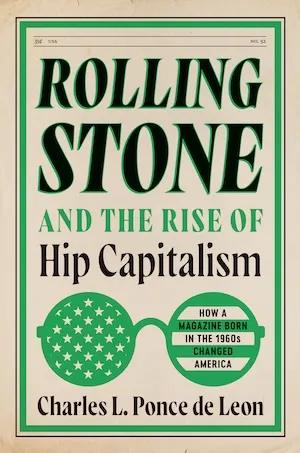
Rolling Stone and the Rise of Hip Capitalism
Charles L. Ponce de Leon (2025). Rolling Stone and the Rise of Hip Capitalism: How a Magazine Born in the 1960s Changed America The University of North Carolina Press, 304 pages, 6 x 9 inches, ISBN 9781469694399
Available here →January 11, 2026
20260211-poncedeleon-charles-rolling-stone
The wide angle
The rest of this thread

Charles L. Ponce de Leon
Charles L. Ponce de Leon was born and raised in Palo Alto, California, and received his BA from UC Santa Barbara, where he was a college journalist and worked in community radio. He received his Ph.D. in United States History from Rutgers University, and has taught at Princeton University, Purchase College, and California State University, Long Beach, where is Professor of History and American Studies.
He is a specialist in U.S. cultural and intellectual history. His fields of expertise include mass media and the commercial culture industries, American intellectual life, and modern U.S. political culture. He has written three previous books: Self-Exposure: Human-Interest Journalism and the Emergence of Celebrity in America, 1890-1940 (University of North Carolina Press, 2001); Fortunate Son: The Life of Elvis Presley (Hill and Wang, 2006); and That’s the Way It Is: A History of Television News in America (University of Chicago Press, 2015).
Pull this thread
Rolling Stone's changes between 1967 and 1987 were pragmatic adaptations to a changing audience and country, not selling out.
Know something the rest of us don't?
Most threads on Rorotoko begin with our invitation. Any thread can begin with a proposal: you write it with the same prompts every thread answers, and we review it.
Propose a thread →