
Quantifying the control laws governing terminal attack in lions
In the last seconds of a chase, lions rely on steering more than speed.
The filming took place at Lion Country Safari in Florida, starting at about half past eight in the morning, before the park opened. The drone went up first and held position at more than seventy metres, which is high enough that the lions did not react to it. A lure attached to a motorised pull box was set out in the grass, and a gate was opened to let a lioness out.
Each chase lasted about sixteen seconds. Watching from the ground, it is difficult to see anything more than the lure moving through the grass and the lion closing on it. The movements that decide the outcome happen too quickly to follow by eye. That was the problem I wanted to solve: how to measure what the lion does, stride by stride, during those seconds.
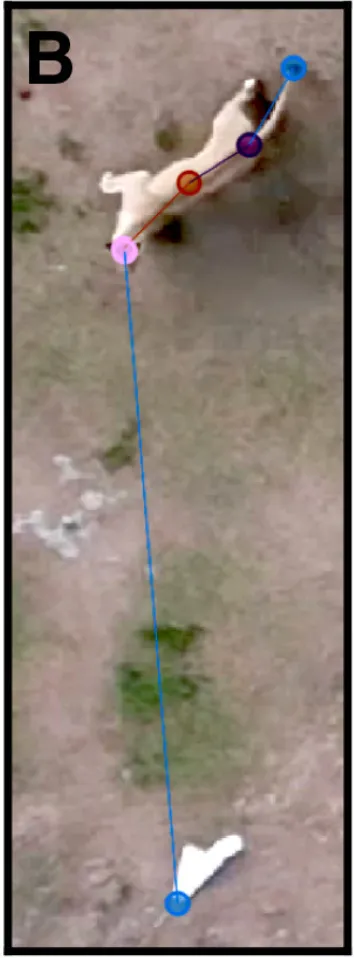
Lions are among the most studied large carnivores, and decades of fieldwork have described how they hunt as a group. Observers have identified roles within a pride hunt: "wings", which circle around the prey, and "centres", which wait for prey to be driven toward them. What had not been measured is how an individual lion converts the movement of its prey into its own steering and speed during the chase itself. This is hard to do in the wild. Lions range over large areas, hunt mostly at night and attack without warning. GPS collars with motion sensors can record a lion's speed and turning, with some error in position, but they record nothing about the prey. A chase involves two moving bodies, and the pursuer's behaviour cannot be understood without the target's track.
In the meantime, biologists working on other species had borrowed the mathematics of missile guidance to describe how animals intercept moving targets. Guidance laws had been fitted to peregrine falcons, dragonflies, bats, predatory flies, tiger beetles, honeybees and Harris's hawks. These are all small animals, and most of them fly. No large mammal running on the ground had been tested.
The tools needed to do this are recent. Consumer drones can now record video at 5.4K resolution from a height that does not disturb the animal. Pose-estimation software, which tracks points on an animal's body across thousands of video frames, can then extract the animal's position in each frame. I used SLEAP, a program developed at Princeton. To convert positions in the video into distances on the ground, I surveyed fixed landmarks in the enclosure, such as poles, fence posts and trees, with GPS and matched them to the same features in the footage.
.webp)
The lure provided the other half of the data. Motorised boxes pulled a cone along fourteen different routes so that the lions could not learn a course, and a meat reward was placed at the end. The keepers were willing to run it because the chases served as enrichment, and the lions needed very little encouragement.
Over four months I recorded 67 chases. That left me with a large set of trajectories and a question about control that I was not equipped to answer alone. I contacted Hadleigh Frost, a theoretical physicist at the Institute for Advanced Study who works on the mathematics of particle collisions, and asked whether he would look at the data. The collaboration that followed produced the paper and we had great fun working together.

.webp)
© Alex Frias
Cash on the Block
Cash on the Block shows what goes wrong when we try to solve a problem without understanding its cause. The problem I focus on is the impoverishment of Black urban neighborhoods in the mid-to-late twentieth century. These neighborhoods had been damaged by specific, quantifiable, institutionally racist practices. Racial segregation barred Black Americans from booming, newly constructed suburbs. Banks refused to lend in the older, urban neighborhoods where African Americans were allowed to reside. Housing speculators and loan sharks exploited the resulting credit vacuum, forcing Black homebuyers to pay exorbitant prices for aging housing. Family savings that could have been reinvested in family and community were instead siphoned off by predatory lenders. Employers were lured by tax incentives to abandon Black urban neighborhoods and set up shop in the suburbs. The federal government spent billions on new highways that served suburbs, while slashing funding for urban public transport. And city governments cut spending on schools, parks, libraries, transportation, garbage collection, and other critical community infrastructure as soon as neighborhoods became majority Black.
To improve these communities, we should have addressed the causes of their decline. We needed enforceable laws to stop real estate professionals from “steering” Black buyers and renters away from white neighborhoods, and banks from refusing loans to creditworthy Black borrowers. This could have undercut the conditions supporting predatory lenders, whose dollar damage to Black communities has yet to be quantified nationally. (A 2019 Duke University study found that between 1950 and 1970 in the city of Chicago alone, predatory housing speculators drained approximately $3.5 billion from Black residents.) We could have stopped giving tax breaks to businesses for moving to the suburbs. We could have improved public transportation in all city neighborhoods. While Black urban neighborhoods deserve extra federal and municipal spending to make up for decades of discriminatory treatment, even a fair distribution of current municipal spending could have improved their schools, parks, libraries, and other services and amenities.
My book shows that logical steps of this sort were rarely attempted. Instead, private and governmental policies attempted to foster reinvestment in Black urban neighborhoods indirectly, by channeling government funds to outside lenders and businesses. Economist Michael Zweig labeled this the “ghetto as conduit” strategy, because it used the existence of racially segregated and disinvested (or “ghetto”) neighborhoods as an excuse to funnel money from taxpayers to elites. A well-known example is the “enterprise zone,” where state or federal governments provide tax breaks to businesses that open in disinvested areas. Businesses have repeatedly exploited such programs to extract payments from governments while providing, at best, insecure, unsafe, and low-wage jobs to neighborhood residents. Even more damaging were government programs that offered 100% Federal Housing Administration (FHA) insurance to financiers who loaned in such communities. Lenders promptly corrupted these programs. They made inflated, high interest, predatory FHA loans to community residents. When residents fell behind on their exorbitant monthly payments, lenders happily collected the full loan amount from the federal government. Such programs enriched outside businesses and financiers, but damaged the communities they were supposedly created to serve.
Ongoing thread. More from Beryl Satter to follow.
© Kate Levy
This week's threads
All the threads →


Overthrowing the Queen
Know something the rest of us don't?
Most threads on Rorotoko begin with our invitation. Any thread can begin with a proposal: you write it with the same prompts every thread answers, and we review it.
Propose a thread →