
Robert Gildea
Children of the Revolution
This is not just a political story, because that only tells part of what is fascinating about France in this period. What are the images we have of France in this period? The Paris of the boulevards built by Baron Haussmann in the 1850s and 1860s that was supposed to make it impossible for revolutionaries to throw up barricades, but which did not prevent the Paris Commune in 1871. The basilica of Sacré Coeur overlooks Paris, built by mass subscription among Catholics who sought God’s forgiveness for the Commune, which desecrated churches and ended in a bout of priest-killing. For France was in the grip of religious war as well as political strife, Catholics against Protestants, Catholics and Protestants against Jews in Alsace, Catholics against anticlericals, deists and atheists.
It was a battle of who was to control the schools, the written word, even the state, and one that was not solved until the separation of Church and state in 1905.
We are familiar with the Eiffel tower, completed in 1889, which symbolised the arrival of France as an industrial power, although at the same time France remained a country of small towns and villages and the French preserved a nostalgia for slow-moving, rural life. We know of George Sand, who had to write under a man’s name, and of Marie Curie, who became a professor only after her husband was run over by a cab.
This book explores the ways in which French women carved a role for themselves in the teeth of marital, professional and political discrimination. We know about Paris as a centre of global culture. Henry James fell out with Flaubert, Winaretta Singer the sewing-machine heiress married a French aristocrat and promoted Verlaine, Debussy and Stravinsky, while Gertrude Stein paid Picasso’s bills. But French culture was also for the masses: the novels of Jules Verne, music-hall star Yvette Guibert immortalised by Toulouse-Lautrec, the cinema of the Lumière brothers, and the Tour de France which brought villagers to their doorsteps.
This is a book which gives a context to the icons, sets the unfamiliar alongside the familiar, proposes a fresh way of looking at a fascinating century of French history.
One of its techniques is to zoom in on particular people or places, then zoom out again to consider the wider picture. The chapter on the religious revival in France after the Revolution starts with the Curé d’Ars, a semi-literate priest who came to a god-forsaken parish near Lyon in 1818 and gradually brought it back to the faith. So great was his reputation that pilgrims came from far and wide and he had an eight-day waiting list for his confessional and he was proclaimed a saint in 1925.
The first chapter on women begins with the story of a young woman whose inclination to follow her own ideas rather than social convention causes her to lose the man she loves, and with whom she is reconciled only in death. This is not a true story but the plot of an 1802 novel by Madame de Staël, Delphine. The book takes the slightly post-modern view that contemporary novels tell us as much about the way in which a society works as bureaucratic reports and economic statistics. Balzac describes ambitious lawyers, money-grabbing bankers, speculators and shopkeepers and land-hungry peasants rocking what he saw as traditional landed society, while Zola describes the same peasants fifty years later, the ruin of small shops by department stores and the growth of the industrial working class in Germinal.
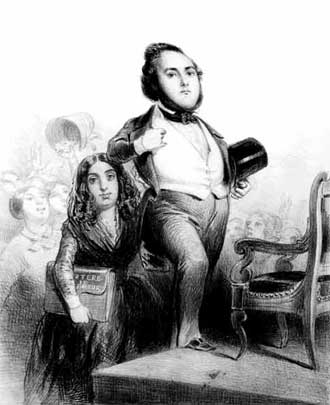
George Sand whispering instructions to the Interior Minister in 1848
Editor: Erind Pajo

Children of the Revolution
Robert Gildea Children of the Revolution: The French, 1799—1914, Harvard University Press 530 pages, 6 1/4 x 9 1/4 ISBN: 978 0 674 03209 5
Available here →December 19, 2008
20081219-gildea-robert-children-of-revolution-the-french-1799-1914-2
The wide angle
The rest of this thread

Robert Gildea
Robert Gildea is Professor of Modern History at the University Oxford. He has spent a lifetime researching French and European history. His previous publications include Barricades and Borders. Europe 1800-1914 (Oxford, 1986, 1997, 2003), The Past in French History (Yale, 1994), France since 1945 (Oxford, 1996, 2002) and Marianne in Chains: In Search of the German Occupation (Macmillan, 2002), published in the USA by Metropolitan/Henry Holt (2003) with the subtitle Daily Life in the Heartland of France under German Occupation, and winner of the 2002 Wolfson History Prize. He has edited Surviving History and Mussolini: Daily Life in Occupied Europe (Berg, 2006) and Writing Contemporary History (Hodder Arnold, 2008). He is currently directing an international project based on interviews with former activists of 1968.
Pull this thread
France took a century to recover from 1789 and found consensus only after the defeat of 1870.
Know something the rest of us don't?
Most threads on Rorotoko begin with our invitation. Any thread can begin with a proposal: you write it with the same prompts every thread answers, and we review it.
Propose a thread →