
Krin Gabbard
Hotter Than That
A casual reader might want to start with page 106, the beginning of “Bending Brass,” the chapter in which I tell the story of my own experience with the trumpet. After playing in grade school and high school, I gave up the trumpet because most of the people in my college dormitory in the late 1960s preferred Frank Zappa and Paul Butterfield to Miles Davis and Louis Armstrong. Although I played in a brass quintet at a Swedish Lutheran church, I really wanted to play jazz. Furthermore, I had crooked teeth that made my horn droop down from my mouth instead of straight out in the heroic posture of the powerful trumpeter. So I quit. Thirty-five years later, I got my teeth fixed.
Shortly thereafter I bought a Bach Stradivarius middle-weight trumpet and began taking lessons. Although I made VERY slow progress, I did spend some time playing with a Latin band in East Harlem. For a brief period I was the band’s lead trumpeter, and on one glorious occasion I hit all seven of the high Cs in a solo in one of the numbers that the band regularly played! I was on Cloud Nine. My fascination with the horn led me to read up on its history and visit several trumpet factories.
At the Monette factory, I made friends with David Monette, one of the most fascinating characters in the trumpet world today. At the end of the chapter I tell the story of my bet with Monette. He promised to give me a $200 gold-plated mouthpiece if I could identify several tiny images engraved on the elaborate flumpet that he had made for the great jazz artist, Art Farmer. Knowing that Art switched between trumpet and flugelhorn, Monette invented a horn that was midway between the two, hence “flumpet.” Read the end of the chapter to find out if I won the bet.
There is no book like Hotter Than That. There are a handful of histories of the trumpet, but they are extremely technical and academic. I like to believe that I have made the instrument come alive as a force in people’s lives. This is why I have included my own experience of the horn along with the role the trumpet has played at different historical moments.
One reviewer said that the book is about how music helps us discover love and that through love we discover the world. The book goes beyond the technical aspects of the trumpet’s history and its manufacture and looks at how people have devoted themselves to playing this most difficult of instruments. Only someone who really loves the horn and the music it makes can master it. I hope that people who read the book will understand what it means to love the horn and its sound.

Art Farmer with a flumpet created by David Monette. (Photo by Ydo Sol.)
Editor: Erind Pajo
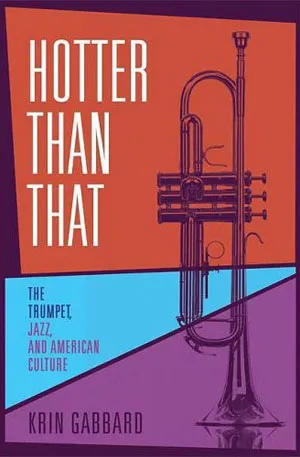
Hotter Than That
Krin Gabbard Hotter Than That: The Trumpet, Jazz, and American Culture Faber and Faber 272 pages, 5 1/2 x 8 1/4 inches ISBN 978 0 571 21199 9
Available here →December 26, 2008
20081226-gabbard-krin-hotter-than-that-trumpet-jazz-american-culture-3
A close-up
The rest of this thread

Krin Gabbard
Krin Gabbard is Professor of Comparative Literary and Cultural Studies at the State University of New York at Stony Brook. He has written on jazz, film, psychoanalysis, and African American studies. His books include Jammin’ at the Margin: Jazz and the American Cinema (1996), Psychiatry and the Cinema (2nd edition, 1999), and Black Magic: White Hollywood and African American Culture (2004). He lives in New York City where he plays the trumpet – not very well – with whomever will let him join in.
Pull this thread
pulls againstpulls alongside
Jazz trumpet let the sons and grandsons of slaves assert manhood loudly and draw applause rather than lynching.
Nearby AT · Macbeth, not only Othello, sits at the center of American racial construction.
Nearby KV · Black social dance from jazz through hip-hop is one continuum, and it made the American body.
Nearby IG · US empire is waning, and the security state is the phase in which it turns to war to stay superpower.
Nearby JH · Rock and roll became white through reception, not production.
Nearby JO · The record refutes the charge that commercial rap damaged the black youth who consume it most.
Know something the rest of us don't?
Most threads on Rorotoko begin with our invitation. Any thread can begin with a proposal: you write it with the same prompts every thread answers, and we review it.
Propose a thread →