
Henry Petroski
The Essential Engineer
Chapter 3, entitled “Which Came First?”, goes over a number of examples of engineering achievements that were accomplished without full scientific understanding or explanation of the phenomena involved. Among those examples are rockets, which preceded rocket science; the steam engine, which preceded thermodynamics; powered flight, which preceded a fully formed science of aerodynamics; and hybridization, which preceded genetics.
Such examples—and the implications they have for the way the world really works—should lead the general reader to a fuller understanding of the nature and practice of science and engineering. I hope that they will be encouraging to inventors and engineers who wish to pursue a goal even in the absence of full scientific support for their idea.
The larger context of The Essential Engineer is its relevance to the world of public policy and legislation.
Since so much of what is considered by lawmakers today is necessarily technological at heart, there is great value in a book laying out clear distinctions between science and engineering and their relationship to the important political and economic goals of innovation and global competitiveness. Legislation intended to promote and support innovation, for example, may have just the opposite effect if it encourages only science, at the expense of engineering, and this should be emphasized to political leaders and lawmakers.
Unfortunately, the distinct endeavors of engineering, invention, and technology are often subsumed under the single rubric “science” and so are not highlighted in their own right. This lack of attention to the true sources of innovation can jeopardize our nation’s future. The Essential Engineer is one attempt to correct this situation.
Editor: Erind Pajo
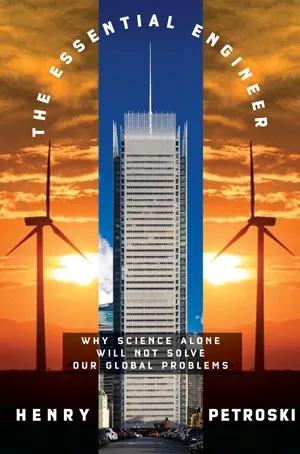
The Essential Engineer
Henry Petroski The Essential Engineer: Why Science Alone Will Not Solve Our Global Problems Alfred A. Knopf288 pages, 9 x 6 inches ISBN 978 0307272454
Available here →March 26, 2010
20090102-henry-petroski-toothpick-technology-culture-3
A close-up
The rest of this thread

Henry Petroski
Henry Petroski is the Aleksandar S. Vesic Professor of Civil Engineering and a professor of history at Duke University. Besides the two books featured in his Rorotoko interviews, The Essential Engineer and The Toothpick, he has also authored thirteen others, including To Engineer Is Human, Design Paradigms, Engineers of Dreams, Invention by Design, The Evolution of Useful Things, Small Things Considered, and Success through Failure. Henry Petroski is a Distinguished Member of the American Society of Civil Engineers, a Fellow of the American Society of Mechanical Engineers, a Fellow of the Institution of Engineers of Ireland, and an Elected Member of the American Academy of Arts and Sciences, the American Philosophical Society, and the U.S. National Academy of Engineering.
Pull this thread
Engineering runs ahead of science, rockets before rocket science, so science alone will not solve climate and energy problems.
Know something the rest of us don't?
Most threads on Rorotoko begin with our invitation. Any thread can begin with a proposal: you write it with the same prompts every thread answers, and we review it.
Propose a thread →