
Jeffrey A. Lockwood
Six-Legged Soldiers
Among the scientific, historical, and military themes in Six-Legged Soldiers, the reader will find three “big picture” ideas, all of which are cause for curiosity and concern.
Using insects as weapons against other humans is a military extension of what is seen as a virtuous scientific practice: biological control. We use insects as predators and parasites to attack pests of all sorts; the same ecological principles that underlie this agricultural practice can be—and have been—applied to entomological warfare. What we are learning today about how to kill pests translates into powerful insights regarding the use of biological weapons, including those with six legs. Indeed, the parallels extend into the entire realm of unconventional weapons. Insecticides are a kind of chemical weapon against pests (the nerve gases are based on an insecticide formulation), and we’ve even used radiation to sterilize insects that are then released as a means of suppressing fly populations.
Next, the history of entomological warfare tracks the history of entomological science—as we’ve learned about the nature of insects, this knowledge has been used to weaponize these creatures. When we learned how to pacify bees with smoke, we were able to use hives as projectiles. Knowing that particular insects harbor potent toxins allowed us to convert these substances into deadly agents. Figuring out which insects transmitted pathogens meant that we could use vectors to spread microbes among our enemies. Having mastered genetics gives us the power—at least in principle—to transform insects into entirely new carriers of horrific diseases, including AIDS. The matching of scientific understanding and military application can also be seen with physics, chemistry, microbiology, and medicine. This is not an argument to halt basic research and discovery. The point is that science is not a value-free enterprise, it does not exist in a cultural vacuum.
The book culminates with an analysis of the asymmetrical conflicts between industrial nations and terrorist organizations. Is the United States prepared for an entomological attack? Based on our inept response to West Nile virus, the answer is “no.” Our public health and pest management infrastructures could not prevent an insect-borne pathogen that arose from a single location in the summer of 1999 from killing hundreds of people and causing terrible neurological damage in thousands more. The federal government’s decision to amass defenses along our borders is a strategic blunder; America should be building a public health system that can detect and quash whatever comes. We have overlooked a great strategic lesson of 9/11. Terrorists only need a little ingenuity, not sophisticated weapons, to cause enormous damage. Armed only with box cutters, the terrorists hijacked planes and brought down the towers of the World Trade Center. Insects are the box cutters of biological warfare—cheap, simple, and wickedly effective.
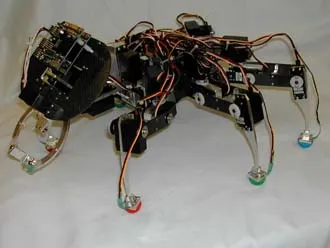
The US Department of Defense is interested in using insects as models for detectors and robots. BILL (Biologically-Inspired Legged Locomotion)-Ant, mimics not only the movement of its namesake but includes actuated mandibles with force-sensing pincer plates. This robot—which hasn’t been drafted into military service—was developed in 2005 by William Lewinger at the Case Western Reserve University Center for Biologically-Inspired Robotics directed by Roger Quinn. (Courtesy of Roger Quinn)
Editor: Erind Pajo
Six-Legged Soldiers
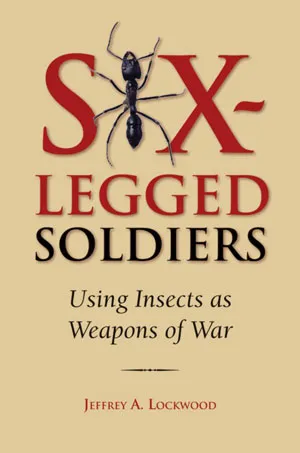
Jeffrey Lockwood Six-Legged Soldiers: Using Insects as Weapons of War Oxford University Press 384 pages, 6 1/8 x 9 1/4 inches ISBN 978 0195333053
Available here →January 16, 2009
20090116-lockwood-jeffrey-six-legged-soldiers-2
The wide angle
The rest of this thread

Ted Brummond
Jeffrey A. Lockwood
Educated as an entomologist and originally working on grasshopper and locust management, Jeff Lockwood metamorphosed into a professor of natural sciences and humanities. He enjoys a split appointment between the department of philosophy and the MFA program in creative writing at the University of Wyoming. In this context, Lockwood explores the interface between scientific knowledge and human values, social practices, and philosophical understandings. His earlier books include two collections of essays (Grasshopper Dreaming and Prairie Soul) and a critically acclaimed popular science/history book, Locust: The Devastating Rise and Mysterious Disappearance of the Insect that Shaped the American Frontier.
Pull this thread
Insects are the box cutters of biological warfare, cheap, simple and wickedly effective.
Know something the rest of us don't?
Most threads on Rorotoko begin with our invitation. Any thread can begin with a proposal: you write it with the same prompts every thread answers, and we review it.
Propose a thread →