
Jeffrey A. Lockwood
Six-Legged Soldiers
An excerpt from the chapter on Japan’s biological warfare program, Unit 731:Merely dumping bacteria into the enemy’s water hadn’t infected enough people to trigger an outbreak. A new approach was needed—or the adaptation of a tried-and-true tactic. If insects were wickedly effective in delivering [bubonic] plague, perhaps these carriers could be conscripted for cholera. From this small leap of entomological logic came the greatest military success in the modern annals of biological warfare.
Japanese epidemiologists realized that the key to triggering the initial wave of infection was to put high numbers of bacteria in intimate contact with even a relatively small fraction of the target population. What Unit 731 sought was a cholera carrier with a strong affinity for humans.
House flies (Musca domestica) get their name for a very good reason—they flourish among human habitations. To be more precise, these insects are what entomologists call “filth flies,” for it is not our houses, but our garbage and sewage that the adults and maggots find so tasty. [Considering] the ease with which house flies could be produced en mass, the Japanese had three of the essential ingredients to trigger a cholera epidemic: bacteria, vectors, and people Yunnan Province had become a thorn in the side of the Japanese. This region hosted an Allied supply line into China, providing Chiang Kai-shek’s nationalist forces with the supplies and arms they needed to resist the Japanese. The route leading from Burma through the city of Baoshan and into southern China made this tropical region one of the most strategically vital areas in the war.
On the 4th of May, 1942, a wave of 54 Japanese bombers descended on Baoshan, dropping tons of explosive and incendiary bombs [along with] a number of ceramic-shelled bombs.
At first, these bombs appeared to be duds—the casings had burst open without exploding. But the nature of these special devices was soon evident. Lin Yoyue, a retired elementary school teacher, described the bizarre contents as being a “yellow waxy substance [with] many live flies struggling to fly away.” He had discovered Unit 731’s brainchild. [The Yagi bomb] was divided into a section packed with a gelatinous slurry of bacteria and a compartment loaded with flies [so that] on impact, the casing burst and the insects were splattered with a slimy coating of cholera bacteria. Released from their confinement, the flies dispersed into the decimated city. The populace had no chance to ponder the unusual invaders, as the Japanese were not done with their dastardly plan.
The planes returned for three more bombing runs on May 5th, 6th, and 8th. Rather than simply moving the rubble around, these attacks had a purpose unique in the annals of aerial bombardment. The goal was to move the people. Sickening Baoshan was a fine start, but the supply route of the Allies could just be moved to bypass the diseased city. The Japanese sought a regional epidemic, and the series of bombings was intended to drive the infected people into the countryside.
By June, cholera had spread into more than half of the counties in Yunnan Province [and] the Allies’ supply line was utterly contaminated. Moreover, with this epidemic raging, the Chinese Nationalist Army could not base troops in the region. By creating this diseased no-man’s land, the Japanese were free to divert thousands of soldiers to other fronts. Any strategy that worked this well seemed worth repeating.
Cholera’s final score from the maggot-bomb campaigns: China 410,000, Japan 0. Yunnan and Shandong became the Hiroshima and Nagasaki of China, with flies and microbes taking as many lives as atomic bombs took in Japan.
While using insects as weapons seems darkly fantastical, the history of entomological warfare suggests that a scenario such as the following is frighteningly plausible.
Dusk descends on a sweltering New Orleans. A naked man lies moaning in an apartment a few blocks from Canal Street. His jaundiced body is mottled with bruises where vessels have hemorrhaged. The pillow and bedside are caked with blood that he has vomited. The man’s breathing is labored as he drowns in his own fluids. The window of the room is shut tightly, letting in no breath of air—and letting out none of the thousands of mosquitoes that cover the walls and the man’s body. Aedes aegypti is not the most common species along the Gulf Coast, but anyone with a course in medical entomology could build a simple trap and conscript a bloodthirsty army. Across the hall, another man cracks his door and peers out. Seeing nobody in the hallway, he emerges wearing beekeepers’ garb. After slipping into the sickroom, he watches as a convulsion wracks the martyr’s body. The insects rise in a ravenous cloud, droning their annoyance at having their meal disturbed. Taking advantage of the moment, the garbed man crosses the room and opens the window. Sensing the air currents, a cloud of mosquitoes pours through the window, carrying a payload of yellow fever. The city’s tropical heat, stagnant waters, crumbling infrastructure, decrepit health care system, and haggard people—nearly a quarter million resolute souls after Katrina—will provide an ideal setting for an epidemic. The man pulls a cell phone from his pocket and reads the coded text messages from his associates in Houston and Miami. He smiles, brushes a mosquito from the key pad, and dials the news desk at CNN.
A vaccine against yellow fever does exist—but that is more than can be said for other mosquito-borne diseases. To be more specific, given our losing battle against West Nile virus, the greatest concern is its African cousin, Rift Valley fever. This virus devastates livestock, and a strain capable of invading the human nervous system emerged in 1977. Of 200,000 Egyptians who fell ill during a single outbreak, some 2,000 lost their eyesight and 598 died of encephalitis. Every region in the United States has a mosquito species capable of transmitting this disease. Consider that a person with $100 worth of supplies, a set of simple instructions, and a plane ticket from an afflicted African nation could introduce the disease to the United States with virtually no chance of being caught. I hope government officials, business and health leaders, and the general public will come to understand that the biological weapons of the 21st century may not be microbial but six-legged.
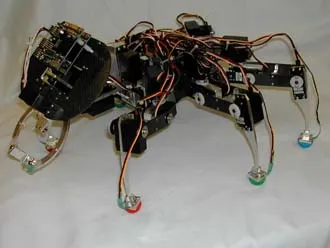
The US Department of Defense is interested in using insects as models for detectors and robots. BILL (Biologically-Inspired Legged Locomotion)-Ant, mimics not only the movement of its namesake but includes actuated mandibles with force-sensing pincer plates. This robot—which hasn’t been drafted into military service—was developed in 2005 by William Lewinger at the Case Western Reserve University Center for Biologically-Inspired Robotics directed by Roger Quinn. (Courtesy of Roger Quinn)
Editor: Erind Pajo
Six-Legged Soldiers
Jeffrey Lockwood Six-Legged Soldiers: Using Insects as Weapons of War Oxford University Press 384 pages, 6 1/8 x 9 1/4 inches ISBN 978 0195333053
Available here →January 16, 2009
20090116-lockwood-jeffrey-six-legged-soldiers-3
A close-up
The rest of this thread

Ted Brummond
Jeffrey A. Lockwood
Educated as an entomologist and originally working on grasshopper and locust management, Jeff Lockwood metamorphosed into a professor of natural sciences and humanities. He enjoys a split appointment between the department of philosophy and the MFA program in creative writing at the University of Wyoming. In this context, Lockwood explores the interface between scientific knowledge and human values, social practices, and philosophical understandings. His earlier books include two collections of essays (Grasshopper Dreaming and Prairie Soul) and a critically acclaimed popular science/history book, Locust: The Devastating Rise and Mysterious Disappearance of the Insect that Shaped the American Frontier.
Pull this thread
Insects are the box cutters of biological warfare, and weaponizing them has tracked entomological science step for step.
Know something the rest of us don't?
Most threads on Rorotoko begin with our invitation. Any thread can begin with a proposal: you write it with the same prompts every thread answers, and we review it.
Propose a thread →