
Mark Fenster
Conspiracy Theories
In fact, two close-ups.
The first is on page 17, a very brief discussion of what the book isn’t, as opposed to the remainder of the introduction, which identifies what the book is. The first edition came out just before a bunch of really fine books from different fields were released, including ones by Jodi Dean in political science and Peter Knight in American Studies, and two essay collections by anthropologists (including one edited by George Marcus). All of us struggled against the expectations that academic books on conspiracy theories would either give a history of them (wide-ranging or focusing on a particular type or period of conspiracy theories) or debunk them. Instead, the books sought to read conspiracy theories symptomatically, as aspects of American culture and democracy.
To those who view conspiracy theories and theorists as dangerous and strange—that is, to someone persuaded by Hofstadter’s assertion that they are pathological—these projects (including my own) appear troubling. We seem to validate conspiracy theories and to waste valuable time and effort that could be spent proving them false. But the problem is that, time and again, the state and media find that showing the factual and logical errors in conspiracy theories doesn’t make them go away. Rather, theorists either deny the errors, revise their theories in different directions towards different factual claims or explanations, or question the authority and motives of those who seek to disprove them. Even if Hofstadter was right—and in fact I appreciate his willingness to consider the conspiracy “style” even as I reject his dismissal of them as “paranoid”—his approach is incomplete.
The cultural, narrative, and logical world that conspiracy theories operate within needs further explanation. This is not to deny the importance of histories and debunkings, but it is to affirm the importance of work that explains the broader as well as the specific context within which such theories emerge and circulate.
The second is on page 278, the final page in the new chapter on the 9/11 conspiracy theories. At that point, I’ve just completed a thick description of Loose Change, the most popular and widely viewed documentary espousing the theory that the state’s explanation of the 9/11 attacks—the al Qaeda conspiracy—is dubious. The chapter as a whole is largely a thick description of such theories, the media that circulate them, and the community of believers that has emerged, especially during 2006, around the time of the attacks’ fifth anniversary.
I remain on the descriptive level purposely throughout the chapter because I think the episode really illustrates what the book as a whole argues: that conspiracy theories operate and succeed as much as modes of narrative and interpretation that offer alternative means to understand the past and present as they do as expressions of political pathology. Loose Change offers a complicated challenge to the dominant explanation, one that’s at heart a simple counter-narrative of corruption and evil, one that calls into being both a political identity—the doubting, persistent, and thoughtful researcher—and a political community—a collective community of knowledge seekers. Viewed as a mode of rhetoric and story telling, it’s a really powerful film, even if I don’t believe much of what it claims.
I hope that the book will be seen as one piece of a larger effort to rethink conspiracy theory.
There are a lot of questions and methods that the book either ignores or glosses over because they were outside the book’s scope. These include insights from social and cognitive psychology, social history, extensive ethnographic research, and from comparisons across culture as well as time. I think the book’s contribution is its critique of the dominant approach to understanding conspiracy theory and its effort, through its reading of texts and practices, to posit a different, more productive way of thinking about conspiracy theories.
I intentionally sought to write the book in a way that would be legible to non-specialist and even non-academic readers without entirely abandoning the scholarly endeavor of working through the existing academic literature. I hoped to strike a note between jargon-heavy books of theory, which no one but a small number of avid academics and intellectuals can follow, and popularizations of scholarship, which lose all the intellectual heft and credibility of the academic endeavor. This is a topic of wide interest and concern, and I’d like to be able to reach those with a serious interest in conspiracy theories—whether because they believe in them or because, like me, they just find them fascinating.
Finally, I would like also to reach across the conspiracy theory divide. When the first edition came out, I sent copies to two people who were quite helpful as I was writing it—a publisher of a conspiracy fanzine and a political activist who writes frequently and forcefully about the danger of conspiracy theories. Both of them told me they liked the book, which seemed like a great accomplishment given their quite different perspectives on conspiracy theories’ value and proximity to the truth.
I fear that because I clearly don’t believe in the 9/11 theories, most members of the “truth movement” will focus only on that chapter and really won’t like the book. That’s fine and inevitable, I suppose, given that I doubt many of the assumptions and assertions upon which they’ve built their community. I would hope that they’d recognize the distinctions I make throughout the book between my approach and the mainstream view of their project, but I hold no illusions about that as a possibility.
Editor: Erind Pajo
Conspiracy Theories
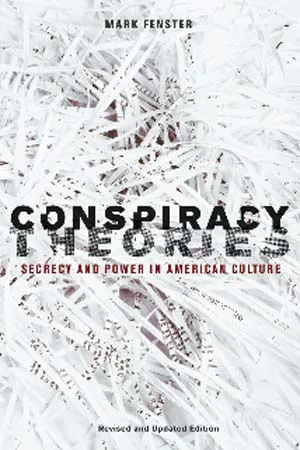
Mark Fenster Conspiracy Theories: Secrecy and Power in American Culture (revised and updated edition) University of Minnesota Press 400 pages, 6 x 9 inches ISBN 978 0816654949
Available here →January 20, 2009
20090120-fenster-mark-on-conspiracy-theories-secrecy-power-american-culture-3
A close-up
The rest of this thread
Joshua Lukman
Mark Fenster
Mark Fenster is UF Research Foundation Professor of Law at the University of Florida. He teaches and writes on legal and cultural theory, administrative law and bureaucracy, and property. He received his B.A. from the University of Virginia, his law degree from Yale Law School, and his Ph.D. from the Institute of Communications Research at the University of Illinois at Urbana-Champaign. He is the author of Conspiracy Theories: Secrecy and Power in American Culture (University of Minnesota Press, 2nd rev. ed. 2008) and is in the midst of two book projects: one on the work of the legal realist and New Deal “trustbuster” Thurman Arnold, and the other on the concept of “transparency” in contemporary law, administration, and culture.
Pull this thread
Conspiracy theory is a subset of populism, which is why showing its factual errors never dissolves it.
Know something the rest of us don't?
Most threads on Rorotoko begin with our invitation. Any thread can begin with a proposal: you write it with the same prompts every thread answers, and we review it.
Propose a thread →