
Mark Fenster
Conspiracy Theories
I came to political consciousness in the 1970s. The first president I remember was Richard Nixon, and the first political controversies I remember were Watergate and the latter days of the Vietnam War. At the same time, the political movies of that era—Three Days of the Condor, All the President’s Men, and the like—suggested that a secret world of power seethed underneath surface appearances. These political and cultural reference points had and continue to have a profound effect on me. My first impulse is to disbelieve those in power, and my taste preferences lead me to novels, television shows, and films that deploy themes of secrecy and conspiracy. Oliver Stone’s JFK came out in 1992, reminding me of this obsession just as I was finishing my dissertation on popular music.
I plunged into research on the world of conspiracy theories and theorists as soon as I deposited the thesis.
I was also in the midst of a career change as I was finishing the book. At the time, I was becoming more interested in studying the law and the state, and was frustrated with the exceptionally limited career opportunities I faced in teaching media studies to undergraduates. My transition to law school and its modes of argumentation colored some parts of the book’s first edition and had an even greater effect on the second edition. While I was writing the new edition’s chapter on 9/11 conspiracy theories, for example, I was thinking not only as a cultural theorist, but also as a lawyer and law professor. I questioned not only what conspiracy theories and this interpretive community say about contemporary popular politics, but also whether the state can respond to conspiracy theories and theorists authoritatively, and if so, how.
The 9/11 Commission provided a great opportunity to think through those questions. Which I actually did twice: once in the book’s final chapter, from the perspective of conspiracy theorists, and once in a separate article I’ve written on the Commission from the perspective of the state. (View a draft.)
Nevertheless, the new edition still retains its strong cultural focus, exploring texts and practices ranging from mainstream popular culture (JFK, The X-Files) to high culture (Delillo’s Libra, Pynchon’s novels) to alternative culture (the independent films of Craig Baldwin) to conspiracy culture (from conferences to fanzines) to fundamentalist Christian culture (including the Left Behind series). The book constantly switches from culture to politics and back again, implicitly arguing that the line between the two is exceptionally fluid—if it exists at all.
Editor: Erind Pajo
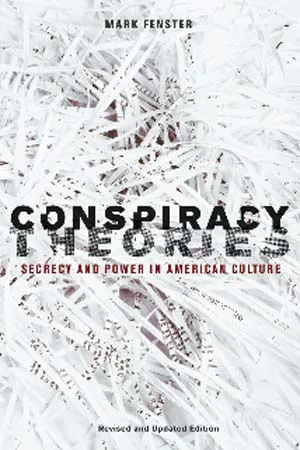
Conspiracy Theories
Mark Fenster Conspiracy Theories: Secrecy and Power in American Culture (revised and updated edition) University of Minnesota Press 400 pages, 6 x 9 inches ISBN 978 0816654949
Available here →January 20, 2009
20090120-fenster-mark-on-conspiracy-theories-secrecy-power-american-culture-2
The wide angle
The rest of this thread

Joshua Lukman
Mark Fenster
Mark Fenster is UF Research Foundation Professor of Law at the University of Florida. He teaches and writes on legal and cultural theory, administrative law and bureaucracy, and property. He received his B.A. from the University of Virginia, his law degree from Yale Law School, and his Ph.D. from the Institute of Communications Research at the University of Illinois at Urbana-Champaign. He is the author of Conspiracy Theories: Secrecy and Power in American Culture (University of Minnesota Press, 2nd rev. ed. 2008) and is in the midst of two book projects: one on the work of the legal realist and New Deal “trustbuster” Thurman Arnold, and the other on the concept of “transparency” in contemporary law, administration, and culture.
Pull this thread
Conspiracy theory is a subset of populism, which is why showing its factual errors never dissolves it.
Know something the rest of us don't?
Most threads on Rorotoko begin with our invitation. Any thread can begin with a proposal: you write it with the same prompts every thread answers, and we review it.
Propose a thread →