
Despina Stratigakos
A Women’s Berlin
Around the turn of the twentieth century, women began to claim Berlin as their own, expressing a vision of the German capital that embraced their feminine modernity, both culturally and architecturally. Women located their lives and made their presence felt in the streets and institutions of this dynamic metropolis. From residences to restaurants, schools to exhibition halls, a visible network of women’s spaces emerged to accommodate changing patterns of life and work.
A Women’s Berlin retraces this largely forgotten city, which arose in the years between German unification in 1871 and the demise of the monarchy in 1918 and laid the foundation for a novel experience of urban modernity. Although the phenomenon of women claming urban space was widespread in this period, Berlin’s concentration of women’s building projects produced a more fully realized vision of an alternative metropolis.
Female patrons called upon female design professionals to help them define and articulate their architectural needs. Many of the projects I analyze in the book represent a collaborative effort uniting female patrons, architects, and designers to explore the nature of female aesthetics and spaces.
At the same time that women were transforming the built environment, they were remaking Berlin in words and images.
Female journalists, artists, political activists, and social reformers portrayed women as influential actors on the urban scene and encouraged female audiences to view their relationship to the city in a radically different light. Women’s remapping of Berlin connected the imaginary to the physical, dreams to asphalt, and inextricably linked the creation of the modern woman with that of the modern city.
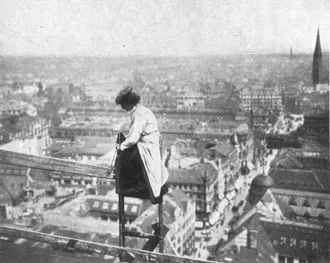
A woman builder making repairs to the roof of Berlin’s town hall, 1910. From Illustrierte Frauenzeitung 38, no. 2 (1910): 17.
Editor: Erind Pajo
A Women’s Berlin
Despina Stratigakos A Women’s Berlin: Building the Modern City University of Minnesota Press 256 pages, 7 x 10 inches ISBN 978 0816653232 ISBN 978 0816653225
Available here →February 13, 2009
20090213-stratigakos-despina-women-berlin-building-modern-city-1
In a nutshell
The rest of this thread

Despina Stratigakos
Despina Stratigakos is Assistant Professor in the Department of Architecture at SUNY Buffalo, and previously taught at Harvard University and the University of Michigan. Her scholarship and activism focus on issues of diversity in architecture. In addition to A Women’s Berlin (2008), she has published on the public image of women architects, the gender politics of the Werkbund, connections between architectural and sexual discourses in Weimar Germany, and exiled Jewish women architects in the United States. She recently curated an exhibition on Architect Barbie, and is currently writing a book on the life and work of Gerdy Troost, Hitler’s trusted artistic advisor and one of the most powerful architects of the Third Reich.
Pull this thread
Berlin women from 1871 to 1918 used monumental buildings to make themselves public citizens.
Know something the rest of us don't?
Most threads on Rorotoko begin with our invitation. Any thread can begin with a proposal: you write it with the same prompts every thread answers, and we review it.
Propose a thread →