
Despina Stratigakos
A Women’s Berlin
The first image in the book depicts a woman builder making repairs to the roof of Berlin’s town hall. Balanced on a ladder high atop the city, this young woman physically intervenes in the urban built environment with her hands and tools. A dense and vibrant urban landscape unfolds beneath her. This extraordinary photograph, taken in 1910, succinctly captures the phenomenon of brave new vistas appearing before women.
As part of a series that documented women in male professions, the image associated the ascent of women to new occupations with the vertical rise of Berlin, linking female modernity directly to that of the city itself.Readers of the Illustrierte Frauenzeitung, a popular Berlin fashion magazine, encountered this striking image of a female builder amid pages devoted to elegant hats and dresses.
The accompanying text introduced her as the first woman to undertake the demanding practical training required for this profession and emphasized the “great deal of courage and self-confidence it takes to stand on a ladder at this height in female clothing and, at the same time, perform a difficult task; in any case, however, this activity should be recommended only to vertigo-free ladies” (1910). While depicting the new horizons opening up to women, then, the magazine’s editors conveyed a sense of danger pertaining to the female body and its clothing.
If her skirt did not snag, the subtext seemed to say, plunging a woman to her death hundreds of feet below, her mental instability (the supposed female tendency to swoon) might lead to a similar ruin. This message, a warning to “lesser” women not to follow in the path of exceptional (and perhaps aberrant) pioneers, was at variance with the calm assurance displayed by the builder. This same confident attitude permeates the chapters of A Women’s Berlin.
The book reveals how women refused to be intimidated by prevalent tales of urban danger and other forms of social and legal harassment, constructing new urban narratives and spaces that embraced an open and optimistic attitude toward urban life and the modern woman. A Women’s Berlin rewrites the history of one of Europe’s great modern cities through the lens of women’s urban spaces, both imaginary and physical.
The Berlin that emerges in these chapters is at once familiar and strange: We recognize the street names, but the maps look different. Place and gender intersect to produce fresh accounts of the city and new meanings in the contested process of modernity. In 1910, Karl Scheffler, alienated by the ceaseless pace of change in the German capital, declared that Berlin was condemned forever to become and never to be. We can and should expect no less of its history, and the story of a women’s Berlin, which interweaves architectural and gendered struggles, encourages us to look anew at the complex making and remaking of a modern metropolis.
A city reimagined and reshaped by women is too vast an entity to be contained in a single book. In selecting themes, buildings, and narratives, I have concentrated on those that highlight an awareness of the role of the urban built environment in the creation of a modern female identity. While I believe the resulting picture is representative, it is by no means exhaustive. More work remains to be done, particularly in understanding women’s physical imprint on the urban fabric. I hope this study acts as a guidebook, sufficiently intriguing readers to prompt further explorations in archives and books and on the city’s streets.
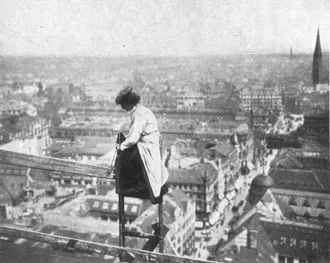
A woman builder making repairs to the roof of Berlin’s town hall, 1910. From Illustrierte Frauenzeitung 38, no. 2 (1910): 17.
Editor: Erind Pajo
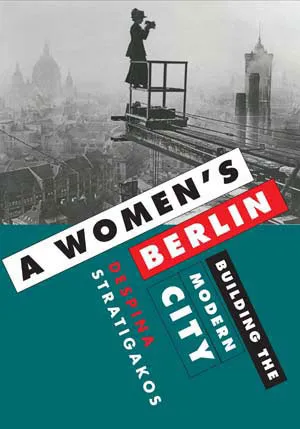
A Women’s Berlin
Despina Stratigakos A Women’s Berlin: Building the Modern City University of Minnesota Press256 pages, 7 x 10 inches ISBN 978 0816653232ISBN 978 0816653225
Available here →February 13, 2009
20090213-stratigakos-despina-women-berlin-building-modern-city-3
A close-up
The rest of this thread

Despina Stratigakos
Despina Stratigakos is Assistant Professor in the Department of Architecture at SUNY Buffalo, and previously taught at Harvard University and the University of Michigan. Her scholarship and activism focus on issues of diversity in architecture. In addition to A Women’s Berlin (2008), she has published on the public image of women architects, the gender politics of the Werkbund, connections between architectural and sexual discourses in Weimar Germany, and exiled Jewish women architects in the United States. She recently curated an exhibition on Architect Barbie, and is currently writing a book on the life and work of Gerdy Troost, Hitler’s trusted artistic advisor and one of the most powerful architects of the Third Reich.
Pull this thread
Berlin women between 1871 and 1918 built an alternative metropolis and used monumental architecture to make themselves public citizens.
Know something the rest of us don't?
Most threads on Rorotoko begin with our invitation. Any thread can begin with a proposal: you write it with the same prompts every thread answers, and we review it.
Propose a thread →