
Louis A. Perez, Jr.
Cuba in the American Imagination
Cuba in the American Imagination examines the emergence of the idea of Cuba in the United States from the early nineteenth century to the end of the twentieth. The book attends to the ways that Americans deployed metaphor and figurative depiction as the principal discursive mode, by which knowledge of Cuba entered the mainstream political culture and popular conventions.
Americans came to know Cuba and Cubans primarily by way of representations of their own making. Which is to suggest that the Cuba that the Americans chose to engage over the course of two centuries was, in fact, a figment of their imagination and a projection of their needs. Americans rarely engaged the Cuban reality on its own terms, or as a condition possessed of an internal logic, or Cubans as a people possessed of an interior history, or Cuba as a nation possessed of an inner-directed destiny.
Metaphors in the nineteenth century included Cuba as neighbor, as ripe fruit, as woman (i.e., damsel in distress, or the “fair sex” in need of protection), and Cuba/Cubans as child/children over whom the United States was obliged to exercise parental authority.
During the first half of the twentieth century, Cuba was imagined as a place of exotic promiscuity, depicted variously as the playhouse of the Caribbean, the Monte Carlo of the Western Hemisphere, and the Red Light district of the Caribbean. After the triumph of the Cuban revolution in 1959, Cuba was depicted as a place of disease, source of infection, and a site of malignancy, all of which required containment and “cure.”
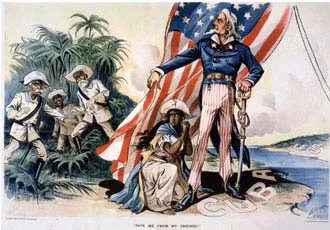
“Save me from My Friends!” Editorial cartoon from Puck, September 7, 1898. The caption reads: “Taking Cuba from Spain was easy. Preserving it from overzealous Cuban patriots is another matter.”
Editor: Erind Pajo
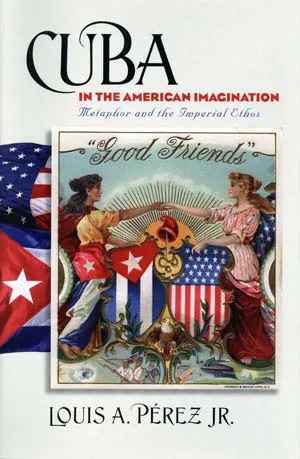
Cuba in the American Imagination
Louis A. Pérez, Jr.Cuba in the American Imagination: Metaphor and the Imperial Ethos University of North Carolina Press 352 pages, 6 1/8 x 9 1/4 inches ISBN 978 0807832165
Available here →March 3, 2009
20090303-perez-louis-cuba-american-imagination-1-1
In a nutshell
The rest of this thread

Deborah M. Weissman
Louis A. Perez, Jr.
Louis A. Pérez, Jr. is the J. Carlyle Sitterson Professor of History and the Director of the Institute for the Study of the Americas at the University of North Carolina at Chapel Hill. Among his books are Cuba: Between Reform and Revolution (3rd edition, Oxford University Press, 2006), On Becoming Cuban: Identity, Nationality, and Culture (University of North Carolina Press, 1999), and To Die in Cuba: Suicide and Society (University of North Carolina Press, 2005).
Pull this thread
The metaphors Americans used for Cuba were not ornament but the mechanism of policy.
Know something the rest of us don't?
Most threads on Rorotoko begin with our invitation. Any thread can begin with a proposal: you write it with the same prompts every thread answers, and we review it.
Propose a thread →